
Importance of Beekeeping
Approximately 75% of food crops are pollinated specifically by bee pollination (USGS 2015). Globally, the increase in food crops that require honey bee pollination has surpassed the number of hives available (Stanhope et al. 2017). Therefore, the western honey bee (Apis mellifera), the most important single species for crop pollination (Mortensen et al. 2021), must be managed proactively to support healthy colonies that can sustain pollination efforts to feed the world.
The honey bee colony is made up of three members. The workers, who are all female, perform tasks such as tending to larvae, building combs, cleaning the nest, foraging, processing nectar and pollen, and defending the colony. The drones are the only male bees in the colony. Their sole purpose is to mate with a queen. They die once they have completed the mating process. The last and most important bee in the colony is the queen. She is solely responsible for mating with drones, laying eggs to produce workers and drones, and emitting regulatory pheromones to help manage the colony (Hickey 2023).
A strong colony needs a healthy queen. In beekeeping, a healthy queen can lay up to 2,000 eggs daily (Shpigler et al. 2022). While a queen's life span can exceed seven years, her productivity drastically declines after one or two years. Due to this decline, beekeepers should practice some form of queen management to keep their honey bee colonies healthy and productive (Anton and Grozinger 2022).
Queen Management for Maintaining a Healthy Hive
Queen management practices include monitoring the queen, queen replacement, marking a queen, and clipping the queen’s wings. To maintain a healthy queen that is laying at her maximum potential, it is recommended to replace the queen annually (Caron et al. 2019). A beekeeper may also find that a queen is not laying well and has a poor brood pattern (Figure 1). If the area of the unsealed brood exceeds more than 20% of the frame, this could be a good indication of a poor brood pattern (Lee et al. 2019).
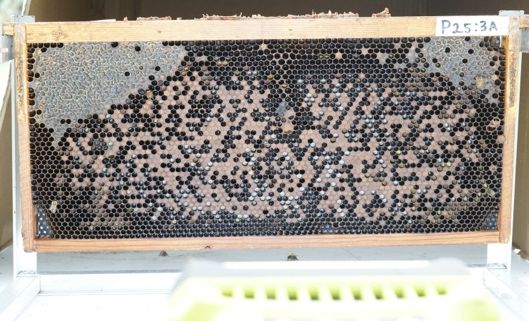
Credit: Devan Rawn, UF/IFAS Honey Bee Research and Extension Lab
There are some steps that a beekeeper can take to help support the health of the colony and ensure proper queen management. This publication will provide detailed explanations of actions beekeepers can take to manage the queens in their hives effectively and practice preventive measures to maintain healthy and strong colonies.
Marking the Queen
Marking a queen is a method to help make it easier to spot her when inspecting the colony and to confirm their age so they can be replaced at necessary intervals (Caron et al. 2019). The first step in marking the queen is to correctly identify her in the colony. The queen is often a slightly different color than other bees in the hive with a larger body and a shiny appearance (Figure 2). Once the queen is found, a cage or queen catcher may be used to isolate the queen from the other bees. For the confident beekeeper, gently picking the queen up by her wings with the fingers also works well (Wood 2023).
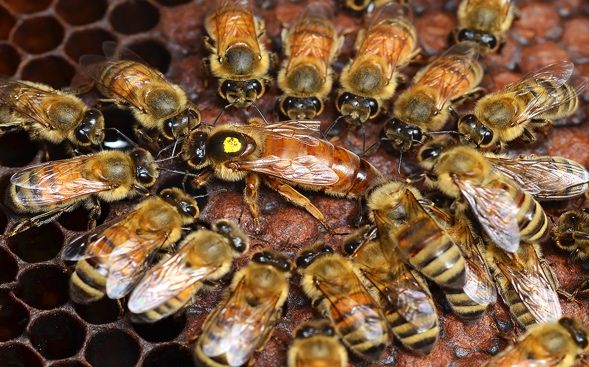
Credit: Mike Bentley, UF/IFAS Honey Bee Research and Extension Lab
A non-toxic queen marking tool is essential when marking the queen. Many beekeepers in the United States use a broad tipped Posca (PC-7M) pen; several other brands make similar, equally suitable marking pens. The color used to mark the queen should depend on the year. Use the international color code to indicate which year the queen was reared and installed (Table 1).
Table 1. Color Marking table.
Once you have identified the appropriate marking color, gently brush the queen on her thorax and allow a few minutes for the paint to dry (Figure 3). (Note: It is often safest to test the marking tool on a different surface before placing it on the queen in case the paint is too runny or comes out too fast.) The final step is to release the queen on a frame. Make sure to watch her for a few moments to ensure that she is received by the other workers well. If the workers begin to behave defensively towards her, you can place her into a queen cage for several hours and release her once the bees have calmed down. You can now find the queen more efficiently and increase effective management practices by knowing her age to prepare to replace her when the time comes (Wood 2023).
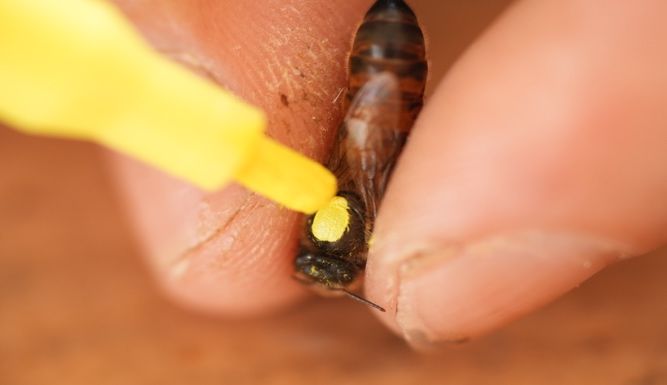
Credit: Ayla Babanikos, UF/IFAS Honey Bee Research and Extension Lab
Clipping a Queen’s Wing
Clipping a queen's wing is one way to practice effective queen management. The forewing of a mated queen can be clipped to reduce the chances of a colony successfully swarming. If the queen attempts to leave the colony in a swarm, she will not be able to fly with a clipped wing and will fall to the ground in front of the hive (DeBerry et al. 2019). Soon, many bees from the original swarm will be found nearby on the ground or in a low shrub, making it easy for the beekeeper to recover the swarm and return it to the original hive.
Clipping a queen’s wing requires patience and precision; first, hold the bee between the thumb and pointer finger of your non-dominant hand (Figure 4). Next, take a small pair of scissors and cut half of one of the large front wings known as the forewing. The queen can then be released to return to her colony. It is important to note that clipping a queen's wing is a management practice to recover queens and bees after a swarming attempt. This method does not reduce stimuli for a colony to swarm. For information on swarm control for managed beehives, see the Ask IFAS publication Swarm Control for Managed Beehives at edis.ifas.ufl.edu.
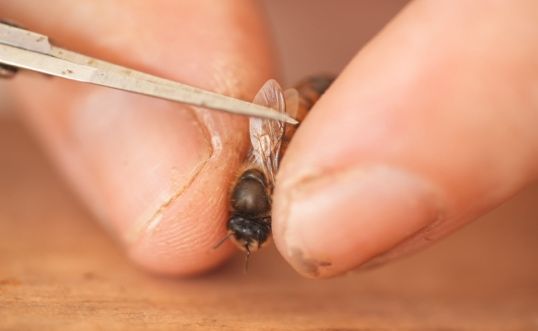
Credit: Ayla Babanikos, UF/IFAS Honey Bee Research and Extension Lab
Requeening a Colony
Observing your bee hive and remaining aware of the behavior of your honey bee colony is crucial for managing the queen effectively. Bees produce queen cells for several reasons. One reason a honey bee colony might produce a queen cell is that the hive has become overcrowded with worker bees. When the colony grows too strong and the hive becomes too full, the bees instinctively prepare to split into two groups to reproduce, a process known as swarming. During this time, they prepare several new queen cells so that the bees remaining in the hive will still have a queen (Stonecipher 2025). Queen supersedure is another reason a beekeeper might spot additional queen cells in the hive. When a queen begins to fail, the reduction in her output of pheromones will prompt the colony to engage in what is called “supersedure behavior” to establish a new queen. Essentially, supersedure behavior is the production of queen cells on the frame. (DeBerry et al. 2019). If you find queen cells in the brood area, it may indicate that it is time to replace your queen (refer to Figure 5).
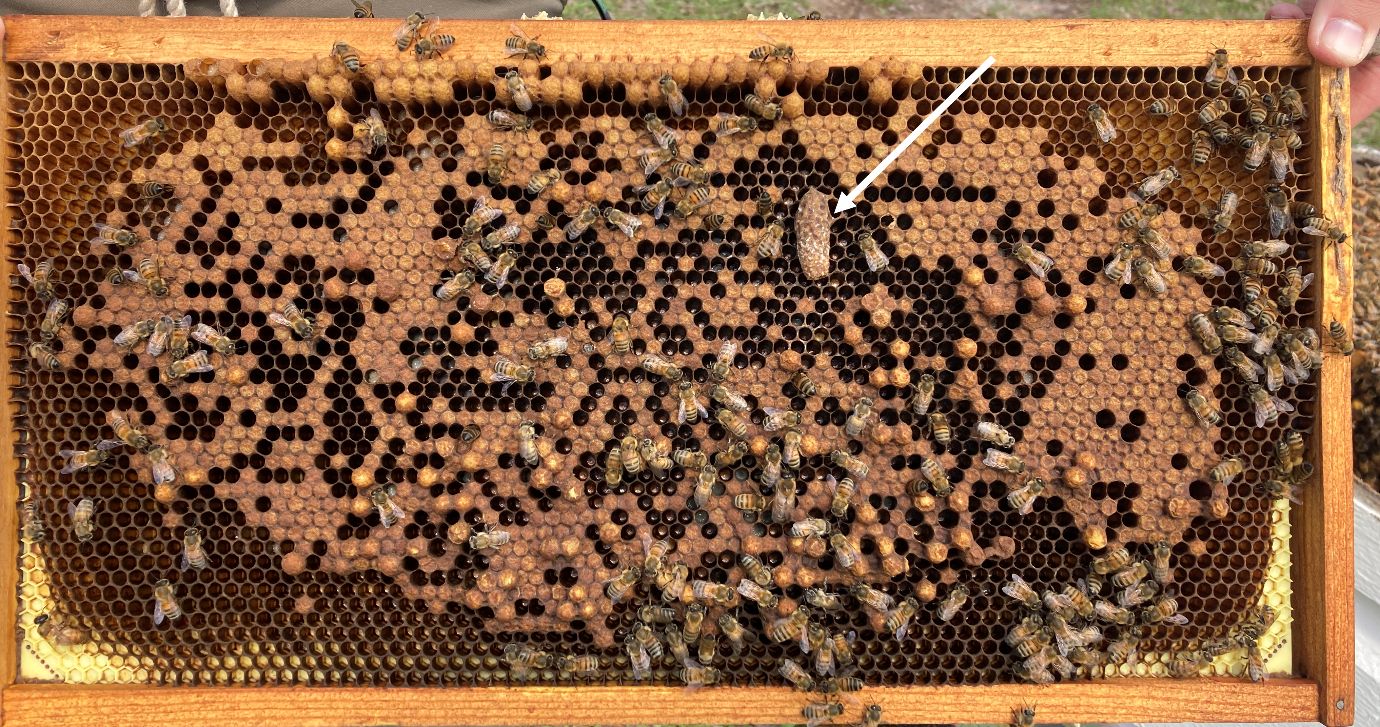
Credit: Devan Rawn, UF/IFAS Honey Bee Research and Extension Lab
The best time of year to requeen a colony is in the late spring or early summer, when queens and drones are most available. There are two main ways for a beekeeper to requeen a colony. You can choose to allow the colony to requeen itself, through swarm cells or supersedure cells, but this can take several weeks and introduces greater risk that the requeening process will be unsuccessful. Typically, a better alternative is to purchase a mated queen to be introduced directly to the colony.
Buying a queen from a reputable breeder is essential to reduce the risk of introducing diseases or unwanted genetics into the colony (Caron et al. 2019). To minimize the risk of African-derived genetics spreading in Florida, queens must be purchased from a producer who has been inspected and certified to show they are producing queens without African ancestry (Florida Administrative Code and Florida Administrative Register 2018). It is ideal to introduce a healthy young queen who is well mated and producing a large amount of pheromone.
Tips for Queen Management
- Mark your queen with the proper color for the year to keep track of the age of the queen.
- Clip half of one forewing of the queen.
- Requeen colonies every year. (Requeening colonies keeps them strong and productive.)
- If an Africanized queen is suspected, replace her with a queen of known pedigree, free from African-derived genetics.
Conclusion
Queen management is an essential part of beekeeping. Maintaining a healthy queen will help reduce honey bee colony losses and aid in sustaining a healthy environment for the bees (López-Uribe and Simone-Finstrom 2019). It is essential to observe and manage your colonies so that you can introduce interventions, if necessary, to aid in preventing colony loss. Use the tools discussed in this publication to give your colonies a better chance of survival year after year.
References
Anton, K., and C. Grozinger. 2022. An Introduction to Queen Honey Bee Development. https://extension.psu.edu/an-introduction-to-queen-honey-bee-development
Caron, D., S. Brunner, D. Epstein, et al. 2019. Best Management Practices for Hive Health: A Guide for Beekeepers. (1st ed.). Honey Bee Health Coalition. https://honeybeehealthcoalition.org/wp-content/uploads/2019/01/HBHC_Hive_BMPs_v1.0_reduced.pdf
DeBerry, S., J. Crowley, and J. Ellis. 2019. “Swarm Control for Managed Beehives: ENY-160/IN970, rev. 7 2019.” EDIS 2019 (July). Gainesville, FL. https://doi.org/10.32473/edis-in970-2012
Florida Administrative Code and Florida Administrative Register. Pests of Honeybees and Unwanted Races of Honeybees, 5B-54 (2018). https://flrules.org/gateway/ChapterHome.asp?Chapter=5B-54
Hickey, L. 2023. “Complex World of Honey Bees: Colony Structure.” UF/IFAS Blogs, October 3, 2023. https://blogs.ifas.ufl.edu/manateeco/2023/10/03/complex-world-of-honey-bees-colony-structure/
Lee, K. V., M. Goblirsch, E. McDermott, D. R. Tarpy, and M. Spivak. 2019. “Is the Brood Pattern within a Honey Bee Colony a Reliable Indicator of Queen Quality?” Insects 10 (1): 12. https://doi.org/10.3390/insects10010012
López-Uribe, M. M., and M. Simone-Finstrom. 2019. “Special Issue: Honey Bee Research in the US: Current State and Solutions to Beekeeping Problems.” Insects 10 (1): 22. https://doi.org/10.3390/insects10010022
Mortensen, A., D. Schmehl, and J. Ellis. 2021. European Honey Bee Apis mellifera Linnaeus and Subspecies (Insecta: Hymenoptera: Apidae). EENY-568. Gainesville: University of Florida Institute of Food and Agricultural Sciences. https://edis.ifas.ufl.edu/publication/IN1005
Shpigler, H. Y., A. Yaniv, T. Gernat, G. E. Robinson, and G. Bloch. 2022. “The Influences of Illumination Regime on Egg-laying Rhythms of Honey Bee Queens.” Journal of Biological Rhythms 37 (6): 609–619. https://doi.org/10.1177/07487304221126782
Stanhope, J., S. Carver, and P. Weinstein. 2017. “Health Outcomes of Beekeeping: A Systematic Review.” Journal of Apicultural Research 56 (2): 100–111. https://doi.org/10.1080/00218839.2017.1291208
Stonecipher, A. 2025. “Honey Bees and Swarming: Understanding This Natural Phenomenon.” UF/IFAS Blogs, February 26. https://blogs.ifas.ufl.edu/volusiaco/2025/02/26/honey-bees-and-swarming-understanding-this-natural-phenomenon/
US Geological Survey Office of Communications and Publishing. “The Buzz on Native Bees.” USGS science for a changing world, June 15, 2015. https://www.usgs.gov/news/featured-story/buzz-native-bees
Williams, M. “The Basics of Requeening a Hive.” PerfectBee, May 16, 2025. https://www.perfectbee.com/blog/basics-requeening-hive
Wood, P. 2023. “How to Mark a Queen Bee—Beginner’s Guide.” Bee Professor, May 26, 2023. https://beeprofessor.com/how-to-mark-a-queen-bee/