
Introduction
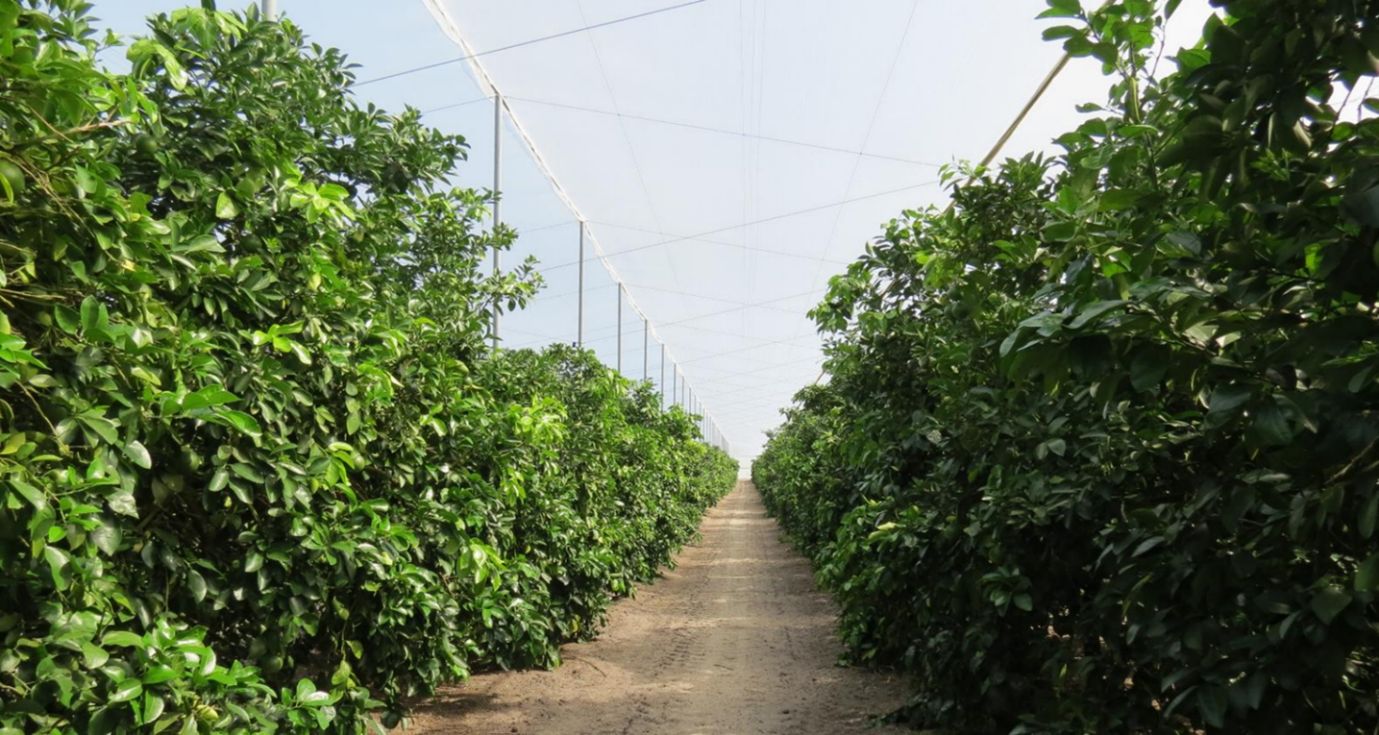
The Citrus under Protective Screen (CUPS) project is a novel approach to citrus production in protected agriculture environments (Figure 1). By shielding trees from the Asian citrus psyllid (ACP), the vector of Huanglongbing (HLB) disease, CUPS aims to produce disease-free, healthy citrus trees and fruit. This innovative method has gained significant attention since its inception in 2014, with CUPS acreage in Florida expanding rapidly. From 2014 to 2025, CUPS acreage in Florida has grown from a single 1.33-acre screen house at the UF/IFAS Citrus Research and Education Center (UF/IFAS CREC) to over 1,500 acres across the state (Schumann et al. 2025). This expansion is a testament to the project's potential in combating HLB and supporting the sustainability and profitability of citrus production. To support the CUPS community, including growers, researchers, and Extension agents, a specialized chatbot named CUPSchat has been developed. This article provides an overview of CUPSchat, its features, and ways it differs from mainstream chatbots.
Credit: Arnold Schumann, UF/IFAS Citrus Research and Education Center
What is CUPSchat?
CUPSchat is a modern artificial intelligence (AI) tool designed to provide instant answers and reports about the CUPS system. It pools 11 years of knowledge about CUPS from 98 documents (as of October 2025), making it a comprehensive resource for anyone seeking information on this innovative citrus production method. CUPSchat can be accessed online at https://citrusdiagnosis.ifas.ufl.edu/CUPSchat/.
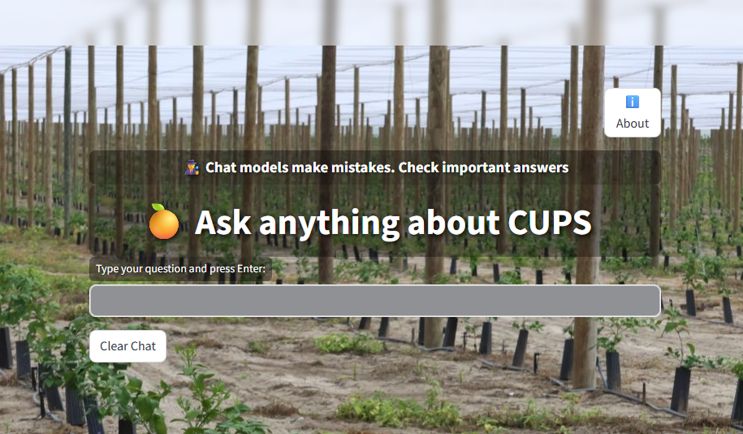
CUPSchat is a large language model (LLM) chatbot (Figure 2), which is a type of conversational AI that utilizes a large language model to generate human-like responses to user queries, providing accurate and informative answers. LLM chatbots can be fine-tuned for specific tasks or domains, allowing them to learn and adapt to provide more precise and relevant responses.
How CUPSchat Differs from Mainstream Chatbots
Credit: Arnold Schumann, UF/IFAS Citrus Research and Education Center
CUPSchat stands out from mainstream chatbots through its use of Retrieval-Augmented Generation (RAG) and its specialized knowledge base of 98 documents (as of October 2025) related to CUPS. Mainstream chatbots often utilize LLMs trained on vast amounts of text data from the internet, which can lead to inaccuracies and irrelevant information when queried about specific topics such as CUPS. In contrast, CUPSchat's RAG framework enables it to retrieve relevant information from its curated database of CUPS documents and generate accurate, context-specific responses. This approach ensures that users receive precise, up-to-date, and relevant information, making CUPSchat a valuable tool for the CUPS community.
Benefits of CUPSchat
CUPSchat offers several benefits to its users, such as the ones listed below.
- Instant access to information: CUPSchat provides immediate answers to questions about CUPS, saving users time and effort in searching through extensive documents.
- Accuracy and specificity: By focusing on CUPS-related information and using RAG, CUPSchat ensures that its answers are accurate and relevant to the user's query.
- Continuous updates: CUPSchat can be continuously updated with new information, ensuring that users have access to the latest research findings and best practices in CUPS production.
- User-friendly interface: CUPSchat is designed to be easy to use, allowing users to ask questions in natural language and receive clear, concise responses.
Tips for Getting the Best Results from CUPSchat
Below are a few useful tips for getting the best results from CUPSchat through the crafting of better prompts.
- Be specific: Clearly define what you want to know or discuss. Instead of asking a vague question such as "What is CUPS?", ask "What are the benefits of using Citrus under Protective Screen (CUPS) for growing grapefruit?"
- Use relevant keywords: Incorporate relevant terms related to CUPS, citrus cultivation, or specific citrus topics you are interested in. For example, "How does CUPS help prevent citrus greening disease?"
- Provide context: Give CUPSchat some background information or context about your question or topic. This can help the chatbot better understand your query and provide more accurate responses. For instance, "I'm a citrus grower in Florida considering adopting CUPS. Can you explain the economic benefits of CUPS?"
- Ask follow-up questions: If CUPSchat provides an incomplete or unclear answer, ask follow-up questions to clarify or seek more information.
- Use clear and concise language: Avoid using jargon or overly technical terms that might confuse CUPSchat. Use simple and straightforward language to help the chatbot understand your query.
- Verify information: While CUPSchat is designed to provide accurate information, it is always important to verify the accuracy of the responses, especially for critical decisions.
- Use CUPSchat's built-in features: Familiarize yourself with CUPSchat's features, such as its ability to collate and interpolate information over time. You can ask CUPSchat to provide updates on specific topics or trends.
By crafting better prompts and following these tips, you can get the most out of CUPSchat and make informed decisions about Citrus under Protective Screen (CUPS) production systems.
Example: Using Better Prompts with CUPSchat
If grapefruit is the citrus variety being grown in CUPS, then the initial prompt is not specific enough to obtain the best answer from CUPSchat. The incorrect leaf nitrogen concentrations are given in the answer.
INITIAL PROMPT: I have 10 acres of CUPS. What should the nominal leaf N% be for maximizing citrus fruit yield?
ANSWER: Research suggests that the optimal leaf N concentration for citrus trees varies depending on factors like tree age, variety, and production level. However, a commonly cited range for optimal leaf N concentration in citrus is between 2.2% and 2.7% (SS47800-Nutrition of Florida Citrus Trees-2nd Ed.pdf).
For your 10-acre CUPS, a nominal leaf N% of around 2.2% to 2.5% might be suitable for maximizing citrus fruit yield. This range allows for optimal tree growth, fruit production, and quality while minimizing potential negative impacts on tree health and environmental sustainability (Let’s Talk about CUPS - Citrus Industry Magazine.pdf).
A prompt with more specific keywords (i.e., “grapefruit” instead of “citrus”) solves the problem, providing a better answer for a grapefruit grower.
IMPROVED PROMPT: I have 10 acres of CUPS grapefruit. What should the nominal leaf N% be for maximizing grapefruit yield?
ANSWER: For maximizing grapefruit yield in a Citrus under Protective Screen (CUPS) system, the recommended nominal leaf nitrogen (N) concentration is between 2.2% and 2.3% (SS47800-Nutrition of Florida Citrus Trees-2nd Ed.pdf).
According to research, grapefruit leaf N concentrations between 2.2% and 2.3% are associated with optimal yields and fruit quality (SS47800-Nutrition of Florida Citrus Trees-2nd Ed.pdf). Leaf N concentrations that are too high or too low can negatively impact yields and fruit quality.
For example, for grapefruit, the recommended annual N fertilizer rate is 120–160 lb/acre, and for groves producing more than 800 boxes/acre, up to 180 lb/acre may be considered (SS47800-Nutrition of Florida Citrus Trees-2nd Ed.pdf).
Potential Limitations of CUPSchat
- Accuracy and reliability: CUPSchat's performance relies on the quality and accuracy of the data used to train it. If the data is incomplete, outdated, or inaccurate, CUPSchat's responses may not be reliable.
- Limited domain knowledge: CUPSchat is specifically designed to provide information on Citrus under Protective Screens (CUPS). It may not be effective in providing information on other topics or citrus production systems.
- Dependence on user input: CUPSchat's effectiveness depends on the quality of the input provided by the user. If the user input is unclear or incomplete, CUPSchat's responses may not be accurate or helpful.
- Lack of human judgment: While CUPSchat can provide valuable insights and recommendations, it may not be able to replace human judgment and expertise in complex decision-making situations.
- Technical issues: Like any software tool, CUPSchat may experience technical issues, such as connectivity problems or software bugs, which can limit its effectiveness.
- Compatibility with mobile devices: CUPSchat is a web-based tool, and its compatibility with mobile devices may vary. Users may experience difficulties accessing CUPSchat on older or lower-end mobile devices.
- User interface: CUPSchat's user interface may not be optimized for users with disabilities, which can create barriers for users with accessibility needs.
- Maintenance and updates: CUPSchat requires regular maintenance and updates to ensure that it remains accurate and effective. If not properly maintained, CUPSchat's performance may degrade over time.
- User expertise: CUPSchat is designed to support citrus growers and professionals, but it may not be effective for users without basic knowledge of citrus production and CUPS.
Conclusions
CUPSchat is a powerful tool for anyone involved in or interested in the CUPS project. Its specialized knowledge base, RAG framework, and user-friendly interface make it an invaluable resource for growers, researchers, and Extension agents seeking information on this innovative approach to citrus production. By providing accurate and specific answers, CUPSchat supports the continued development and success of the CUPS community.
References
CUPSchat. n.d. “CUPSchat.” https://citrusdiagnosis.ifas.ufl.edu/CUPSchat/
Schumann, A. W., A. Singerman, M. A. Ritenour, J. Qureshi, and F. Alferez. 2025. “2025–2026 Florida Citrus Production Guide: Citrus under Protective Screen (CUPS) Production Systems: CPG ch. 21, HS1304/CMG19, rev. 8/2025.” EDIS. https://doi.org/10.32473/edis-hs1304-2023
Acknowledgments
This material is based upon work that is supported by the National Institute of Food and Agriculture, U.S. Department of Agriculture, under award number 2018-70016-27387, the Florida Department of Agriculture and Consumer Services Specialty Crop Block Grant, and the UF Citrus Initiative.
CUPS research project page: https://www.makecitrusgreatagain.com/CUPS.htm
Disclaimer
The use of CUPSchat is subject to the terms and conditions outlined on the chatbot's website. Users are encouraged to verify chatbot answers for mission-critical questions and use CUPSchat with discretion, as with any AI tool.