
Overview
This publication provides information about ospreys (Pandion haliaetus). Further, it discusses an osprey cam that was placed on several nests at the University of Florida campus in Gainesville, Florida. This osprey cam is a camera that streams video online. When operating, the public can view ospreys and their behaviors on a nest 24/7. This publication is for anyone interested in learning more about ospreys.
The osprey (Figure 1), or “fish hawk,” is a large, fish-eating bird of prey commonly found throughout Florida. With a wingspan of up to six feet, brown upper parts, and a white underside, ospreys are easy to spot gliding over water or perched near shorelines and waterbodies. Ospreys are unique among raptors: they are the only species in the family Pandionidae and are globally distributed across every continent except Antarctica. In Florida, they are mostly year-round residents, benefiting from the state’s abundant water bodies, warm climate, and healthy fish populations. Some of the ospreys that breed in Florida migrate to South and Central America in the winter. During peak migration (fall and spring), Florida becomes a major stopover and wintering ground for ospreys flying between North America and South America. Ospreys are typically seen along coasts, estuaries, lakes, rivers, and even urban areas with nearby water access. An osprey’s lifespan is about 20–25 years.
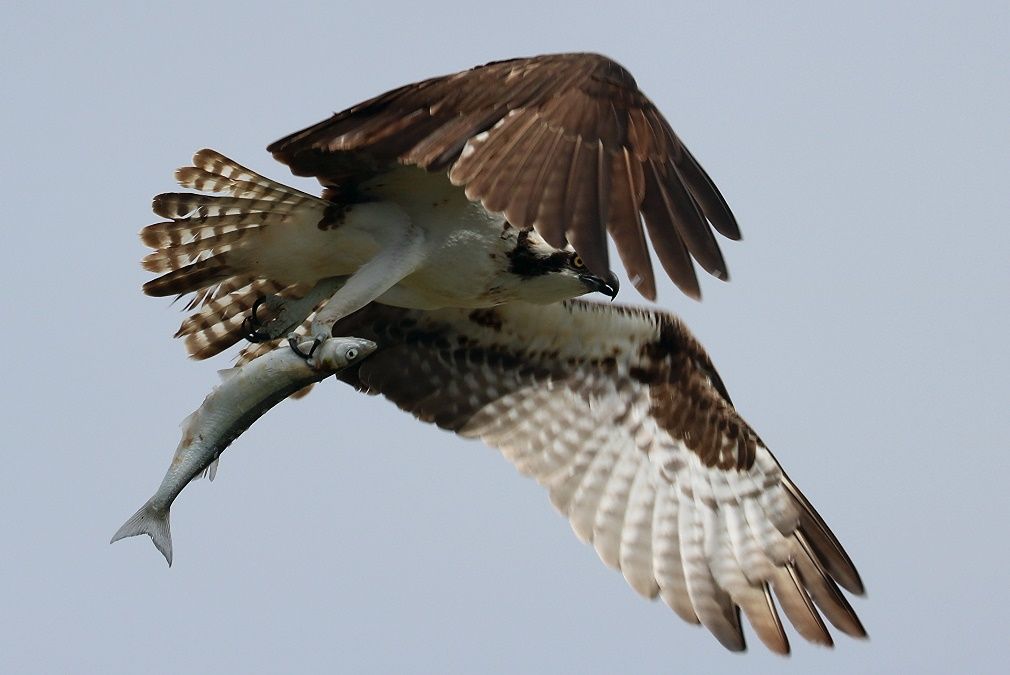
Credit: David A. Hofmann, licensed under CC BY-NC-SA 2.0, available at flickr.com.
Osprey Reproduction in Florida
Florida’s mild winters allow ospreys to begin nesting in the state earlier than they typically do in northern states.
- Breeding Season: December through May
- Clutch Size: Typically 2–3 eggs, only one clutch per breeding season
- Incubation Period: 35–43 days
- Fledging: 7–8 weeks after hatching
- Courtship: Pairs engage in aerial displays and fish-sharing rituals. Ospreys are mostly monogamous and often return to the same nesting site and pair with the same mate each year. The male also provides fish for the female as part of courtship.
Osprey Nest Characteristics
Ospreys build large nests called eyries (Figure 2). They frequently reuse the same nest for years, enlarging it each season. Generally, the male brings most of the material to the nest.
- Nest Sites: Dead trees, utility poles, channel markers, cell towers, artificial platforms
- Materials: Sticks, Spanish moss, seaweed, palm fronds, human-made debris
- Nest Height: Usually 15–100 feet above ground or water
- Nest Weight: Can exceed 200 pounds after years of use
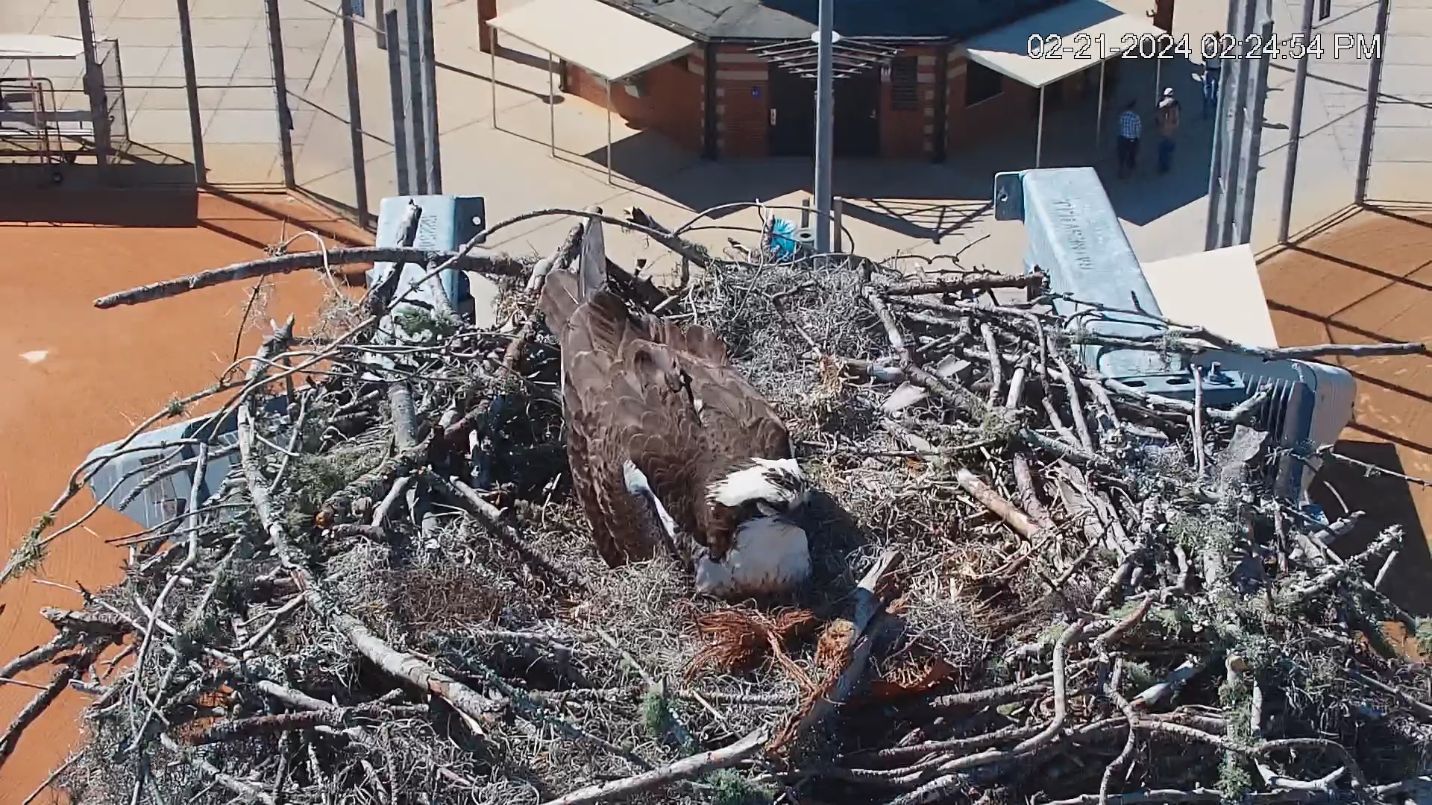
Credit: Mark Hostetler
Osprey Behaviors
- Hunting Behavior: An osprey’s diet is 99% live fish. Ospreys have excellent eyesight and hunt by hovering over water and diving feet-first to snatch fish near the surface (Figure 3). They have long, curved talons with spiny footpads (spicules) that keep a tight grip on the fish.
- Flight: Strong, gliding flight with deep wingbeats; often seen carrying fish with the head facing forward.
- Vocalizations: Loud, whistling chirps, especially around nests.
- Territorial Displays: Males may perform “sky-dance” flights during breeding season. With dangling legs, often clasping a fish or a piece of nesting material in his talons, the male alternates periods of hovering as high as 600 feet or more above the nest site with periods spent making slow, shallow swoops close to the nest.
- Daily Activity: Ospreys are diurnal hunters and are especially active in the early morning and late afternoon.
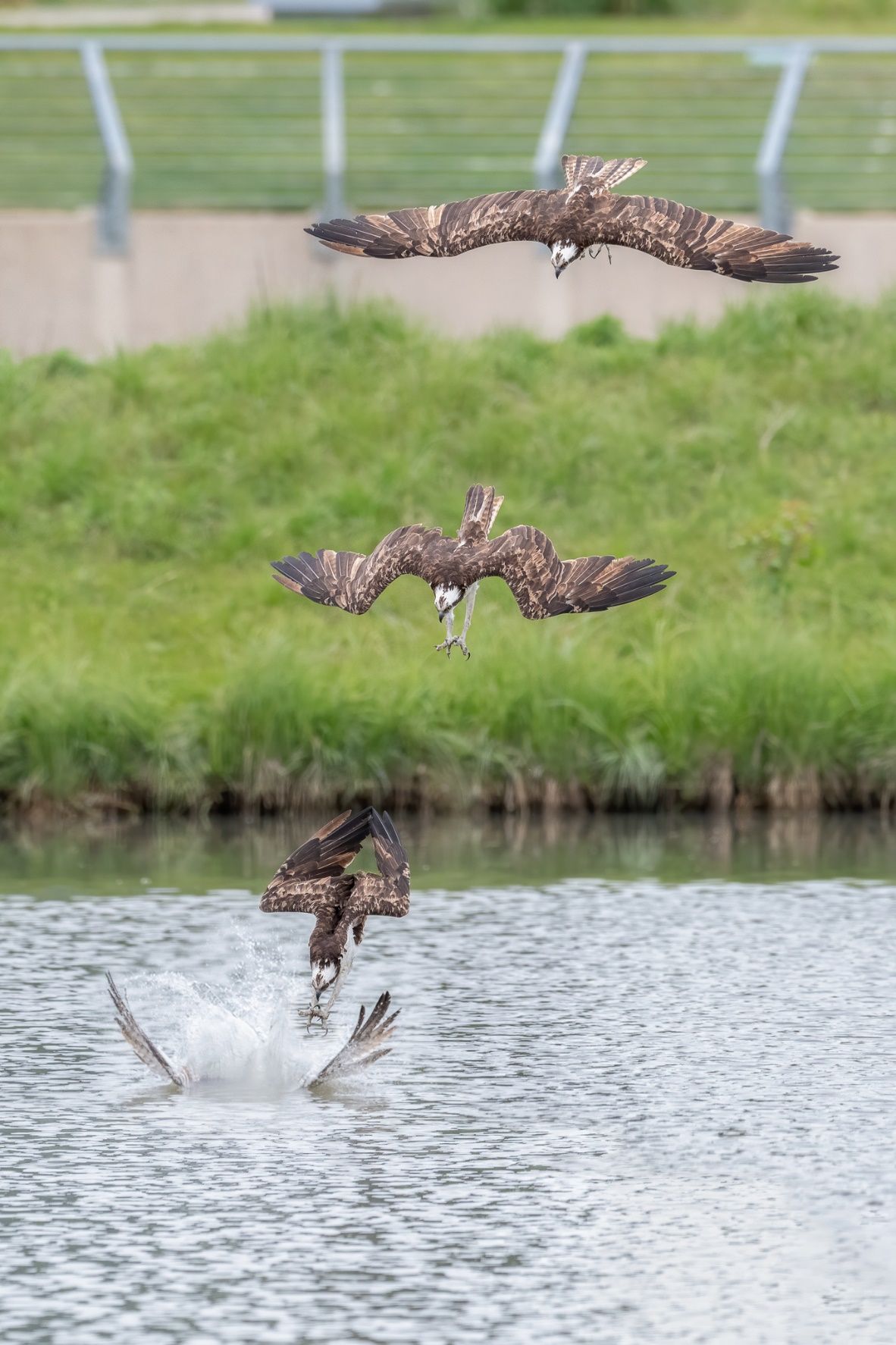
Credit: "Osprey Dive Sequence" by Sunny is licensed under CC BY-NC-SA 2.0 and is available at flickr.com.
Osprey Conservation in Florida
Ospreys experienced major declines in the United States during the 1950s–70s due to widespread use of a pesticide called dichlorodiphenyltrichloroethane, more widely known as DDT. DDT thinned the eggshells of many species of birds and reduced their breeding success. After DDT was banned in 1972, osprey populations in Florida and across the United States rebounded strongly.
Conservation Status in Florida:
- Protected under: Migratory Bird Treaty Act
- International Union for Conservation of Nature (IUCN) Status: Least Concern
- Not listed as threatened or endangered in Florida, though local protections vary by county
Current Threats Today:
- Habitat loss and waterfront development
- Entanglement in fishing line and netting
- Storm damage to nests
- Human disturbance near nesting areas
You Can Help Protect Ospreys by:
- Disposing of fishing line properly
- Reporting damaged nests or injured birds (contact the Florida Fish & Wildlife Conservation Commission’s Wildlife Alert Hotline at 1-888-404-FWCC [3922])
- Supporting artificial nesting platform programs
- Limiting fertilizers, irrigation, and pesticides used on lawns and landscapes; this reduces polluted runoff that could negatively affect fish populations upon which ospreys depend.
The Osprey Cam at the University of Florida
The UF/IFAS Department of Wildlife Ecology and Conservation (WEC) has installed an osprey cam at an osprey nest at the University of Florida. When the osprey cam is operating, it is kept on 24/7 so that people can go online and see the osprey family—or, if the family is not at home, at least their nest. The department website at wec.ifas.ufl.edu offers this round-the-clock coverage where the public can view osprey courtship behaviors and incubation of the eggs and chicks and stay tuned later in the breeding season to see how the adults take care of and feed the chicks when they hatch. Typically, the camera is turned on February 1 and remains on until June 30. Below, we give a brief history about the osprey cam at the University of Florida, significant events that have happened to the ospreys, and how the public has interacted with the ospreys over the years.
Because ospreys prefer to nest in areas with open surroundings that are safe from ground predators, most of the osprey nests at the University of Florida are built on the top of light poles there. Originally, the University of Florida osprey cam was installed at Alfred A. McKethan Baseball Stadium. This camera was operational from 2017 to 2018. The most recent camera and nest are on a pole at UF’s Southwest Recreation Center near the softball fields. This camera operated in 2022, 2024, and 2025.
Over the years, the ospreys had both nesting successes and failures with nesting and breeding. In 2017 and 2025, they had total nest failure after a heavy rain opened a hole in the nest and the eggs fell through to the ground. In 2018 and 2024, one chick fledged successfully. In 2022, two chicks fledged successfully. In another significant event, the male went missing in 2024 and the female had to raise a chick all by herself.
The audience of the osprey cam was quite involved in reporting activities and in naming the osprey family. In 2022, from a naming contest of the pair of ospreys at UF’s SW Rec Center, the male was named Talon and the female Stella. The chicks were named Breezy and Windy. The nest itself was named The Cheap Seats or Home Plate. We hope to continue to offer the osprey cam to the public in the future. Figures 4, 5, 6, and 7 follow and provide some interesting photos from the osprey cam.
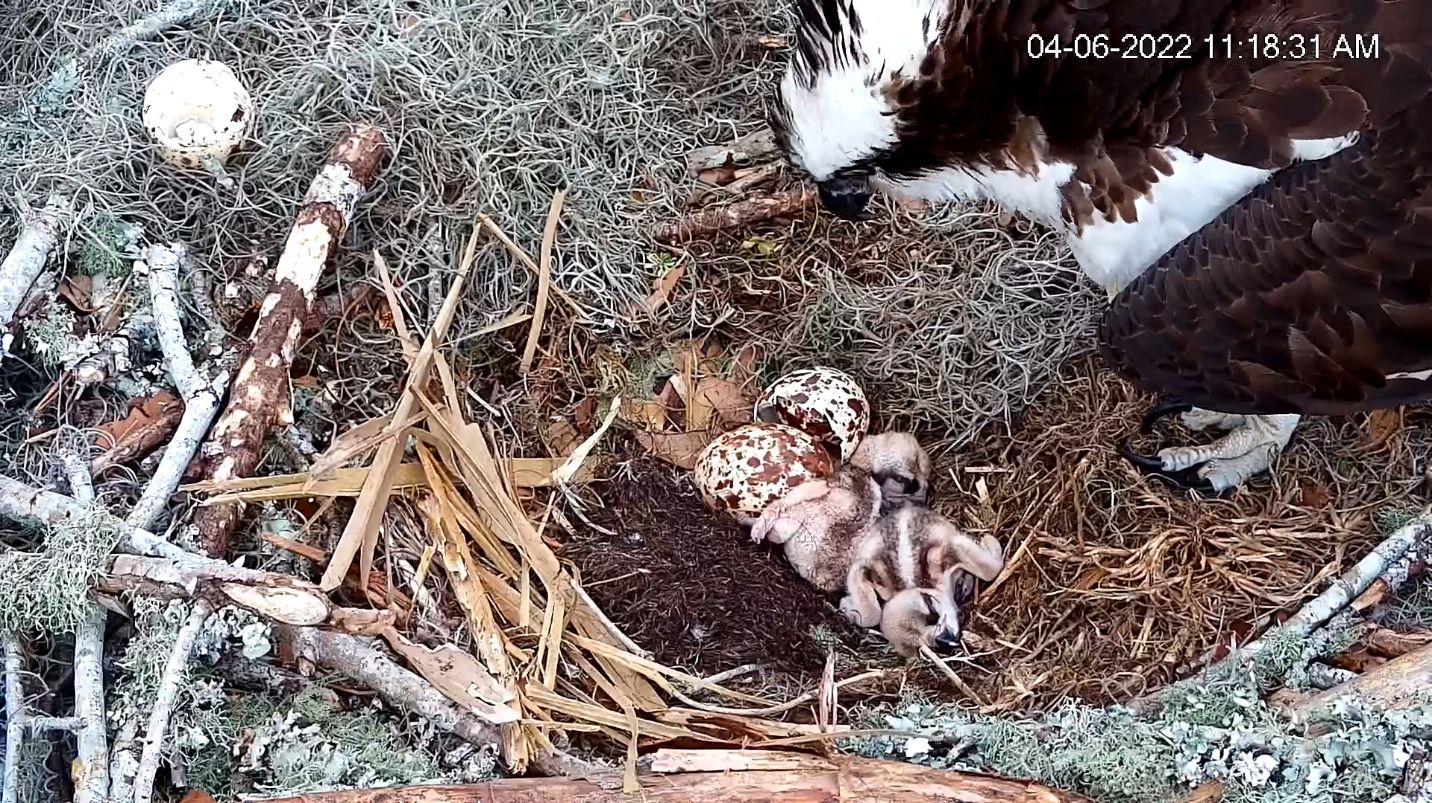
Credit: Mark Hostetler
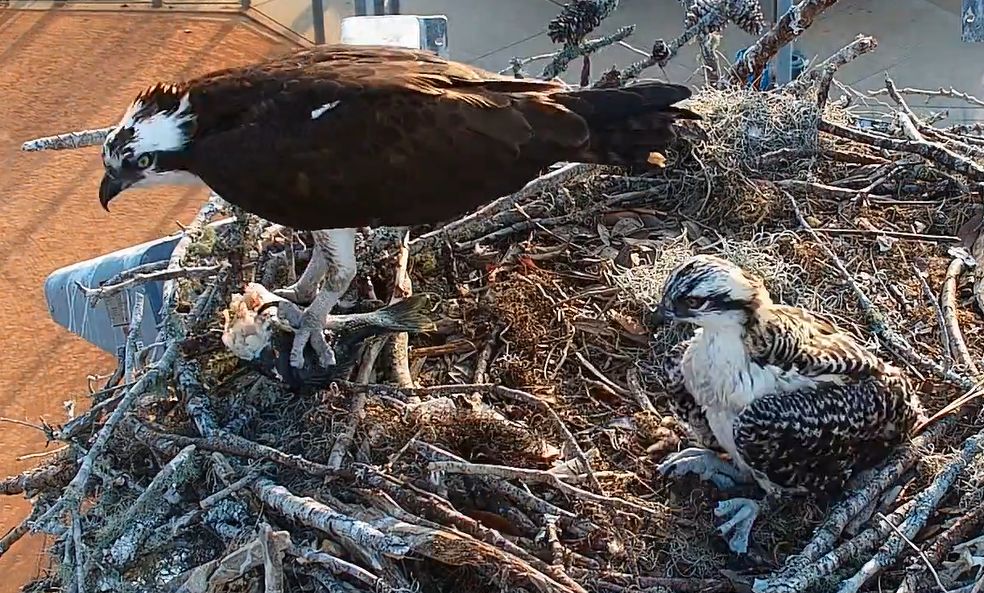
Credit: Mark Hostetler

Credit: Mark Hostetler
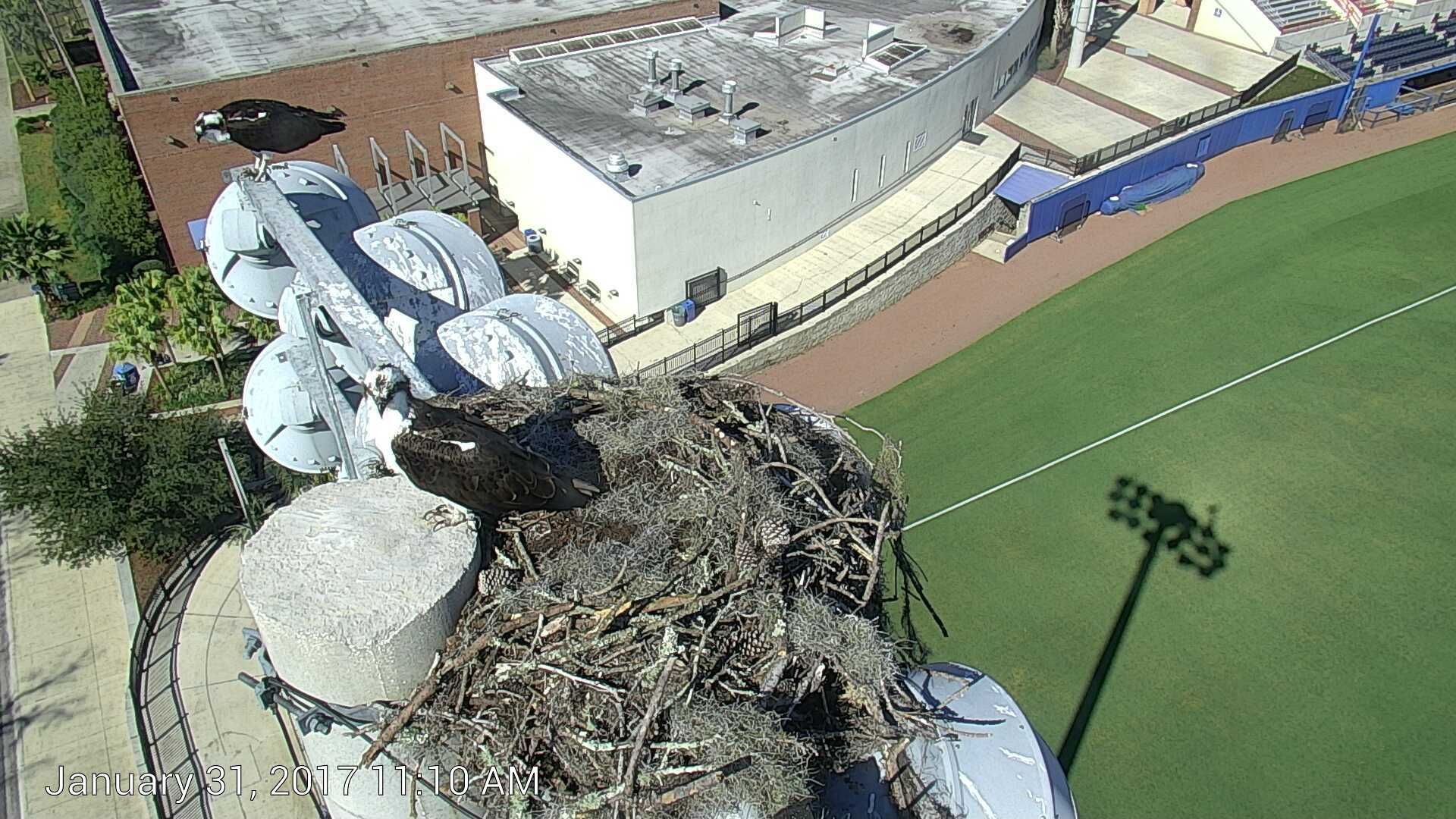
Credit: Mark Hostetler
Further Reading
- Osprey — from Audubon at Audubon.org
- Osprey Pandion haliaetus — from the Florida Fish and Wildlife Conservation Commission at myfwc.com
- Osprey — from Britannica Kids at Britannica.com
- Osprey — from Cornell Lab All About Birds at https://www.allaboutbirds.org/news/