Introduction
Organizations, including research teams and centers, non-profits, industry and government recruiters, and university departments hoping to attract students, often staff tables at career expos such as those at national conferences. Successfully sharing your messages and learning about what conference attendees may be looking for requires preparation of both materials and speaking points to share. While this preparation does not have to be extensive or require deep knowledge of education principles, thoughtful preparation can help your representatives feel comfortable and present your organization to its best advantage. This publication, intended for anyone who may coordinate an organization’s representation at a similar event, will take you through the steps of planning, materials preparation, and setting up and staffing a conference booth at a career expo.
This publication is one of a series related to work from the Internet of Things for Precision Agriculture (IoT4Ag), a National Science Foundation-funded Engineering Research Center.
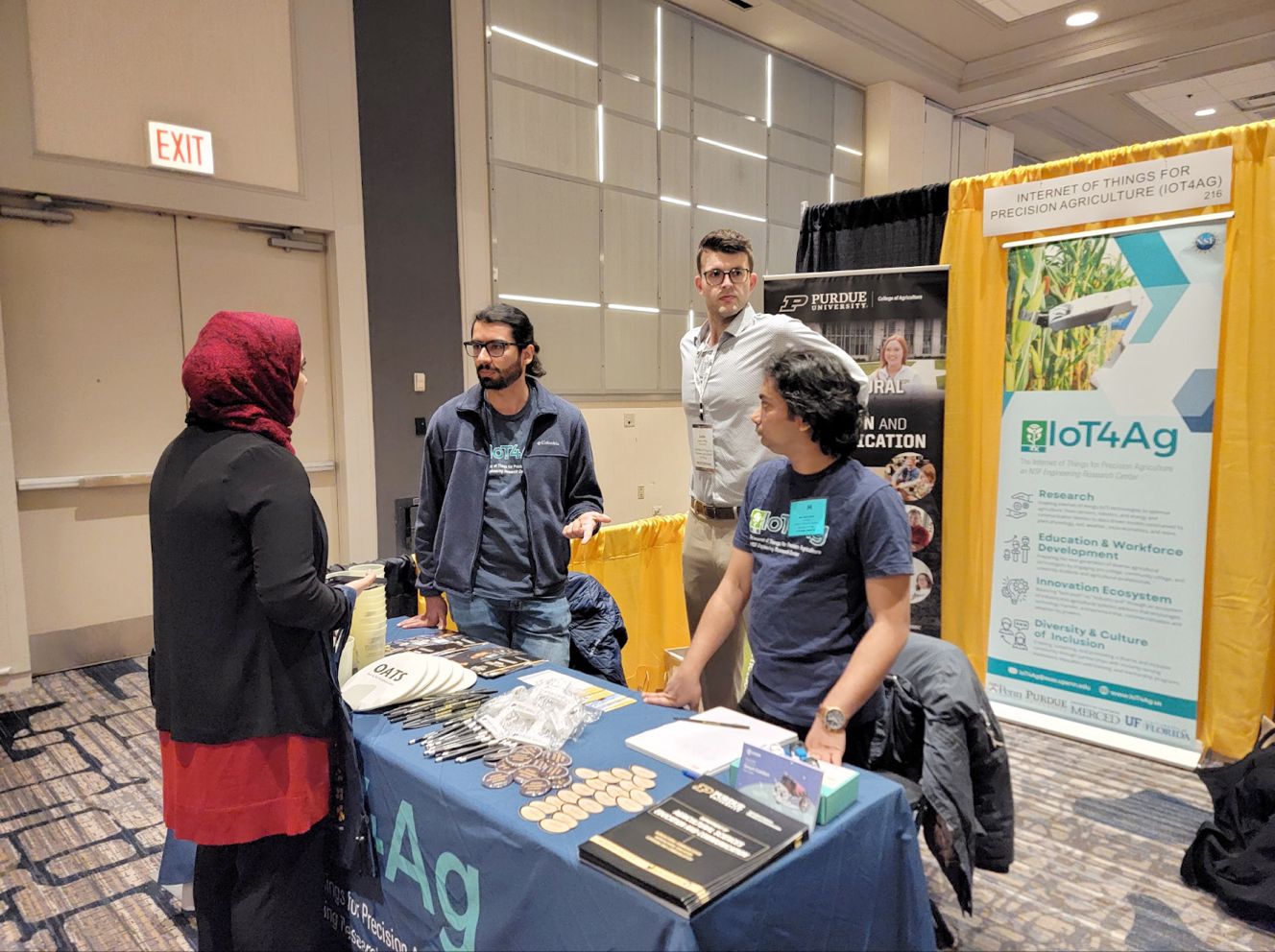
Credit: Yaguang Zhang
IoT4Ag Center Background
The Internet of Things for Precision Agriculture Center (IoT4Ag) launched in 2020. Four universities conduct fundamental engineering research designed to create internet-enabled and networked technology to improve precision agriculture. The funding also includes specific focus on preparing a workforce “to address the societal grand challenge of food, energy, and water security” (IoT4Ag.us, 2024). The Center therefore advertises research opportunities through professional organizations including the American Society of Mechanical Engineers, the American Society for Engineering Education, and Minorities in Agriculture, Natural Resources, and Related Sciences (MANRRS). This document originates from Center personnel who attended and staffed career expo tables at the MANRRS national conference in April 2024. Read more about the Center on the website or in Kagan et al. (2022).
Prepare for the Event
Both materials and personnel who will represent your larger organization can be prepared in advance, starting before the organization signs up to exhibit. Information to gather from conference hosts, preferably before registering for the booth (up to several months in advance of the conference), includes:
- What size booth will you have?
- What is provided? For example: are booths blocked off by “pipe and drape” curtains or other more durable materials on which you can hang signs? Will you have tables and chairs, and if so, how many? Will you have access to electricity or internet?
- Can you choose your location? Or, what do you know about your location within the hall?
- At MANRRS 2024, the IoT4Ag booth was located at the end of an aisle, so traffic may have been reduced. However, a location on the main floor offers opportunities that booths in smaller rooms do not offer.
- If your team has an accommodation need for you or your anticipated attendees, such as a location near a bathroom, accessible table or booth, microphone, or a location away from the main area to minimize sensory stimulation, be sure to request those separately even if the option is not generally available to all exhibitors. Asking early will allow you to budget or arrange for these items if the conference cannot provide them.
Understanding Attendees
- How many people will be expected, and who (i.e., ages, career stages, reasons for attending the conference and career expo)?
- What are the accessibility considerations or accommodation needs you need to prepare for attendees? See Stofer (2018).
Personnel and Logistics Considerations
- What time and date will the expo happen, and for how long? How much time is there to prepare? When will you set up and break down?
- How many people (maximum and minimum) at a time staff the booth, and what are the registration fees for booth staff and the booth itself?
- Who is the contact person during the event (if different from the pre-event contact)?
Sharing information about the expected attendees with your potential personnel can help them know what to prepare and expect and whether they feel they will be a good fit to engage with the attendees. Sharing information about the logistics will also prepare your personnel to arrange their own accommodations, if any. See Stofer et al. (under review) for specifics on what to share and how to prepare research personnel to facilitate career expo booths.
Set Goals for the Event
First and foremost, once you have gathered information about the event and determined it could be worth pursuing, the organizational leadership needs to clearly understand why they wish to be represented at the event (Farnsworth et al., 2020). Define clear, measurable outcomes, such as “Talk to 50 undergraduates who we can contact next year for summer research experiences” or “Share our public webinar series with 50 PhD students.” Setting goals will drive what materials to take, who should attend to represent the organization, and how to prepare those who will represent. Having these conference attendance goals align with an overall engagement plan for the organization will provide clarity in making these decisions.
Decide Who Will Attend
Resources also dictate the conferences of most interest and the number of people who can attend. However, given those constraints, offering multiple perspectives in terms of background, career level, discipline, and research focus can provide the best experience for attendees, both organization exhibitors and conference participants. Consider the audience attending and who from the organization might best speak to those attendees. A second publication in this series (Stofer et al., under review) covers specifics for preparing the personnel who will represent your organization at the event. For IoT4Ag, the administrative director of the Center and the education director regularly attend on behalf of the Center, especially if researchers themselves cannot. For MANRRS 2024, some consideration came from the location of Purdue University, within driving distance of the conference location in Chicago, Illinois. In the end, one faculty member from Purdue University, one PhD candidate from UF, and two PhD students from Purdue exhibited. The researchers represented 4 of 28 active projects in the Center’s research and multiple departments at their universities: Agricultural and Biological Engineering, Electrical and Computer Engineering, and Education and Communication. Consider supplementing in-person representatives with an array of photos and videos that showcase the variety of your organization’s members to the extent possible.
Another option to consider when your organization is networked with other groups is to share a single booth to promote your efforts. That can save monetary, time, and personnel resources while offering a broader picture of opportunities to expo attendees. For example, with IoT4Ag, the undergraduate and graduate internships and programs we promote are limited in two ways: the agriculture and engineering focus of the Center; and a limited number of paid positions available in certain locations, the application periods for which may not coincide with the expo timing. Our Center can promote general interest programs such as our Pathways to PhD Program, which offers mentoring to students interested in learning about graduate studies and is only limited by the number of mentors we have available. On the other hand, by partnering with other Engineering Research Centers in a single booth, we could expand both the disciplines and availability of positions while sharing the booth staffing burden and opportunity among centers. Our Center is pursuing such a collaboration going forward.
Prepare Your Materials
The materials you bring to advertise your booth offerings and to give away to participants are crucial. At many events, an interactive activity such as a prize wheel or obvious goodies to give away can attract people to talk to you. This can be especially helpful if your booth is in a suboptimal location or you have a story to share that may be new to attendees versus the name recognition of universities or industries. Consider creating a set of materials that you take to all kinds of events in a kit, so you can more easily prepare for expo events. A checklist of materials can help you ensure everything is in adequate supply before departing for the event, as well as efficiently packing up to return home.
Options for getting materials to the event include shipping them to the conference organizers or hotel (who may charge for storage), or carrying them on an airplane or other transport with the personnel representing. Budget for shipping, storage, and/or luggage costs.
A note on banners, signage, and tablecloths: Before the event, ensure all pieces are present and that the packed materials are the ones you want, such as a specific program banner versus a different or broader organization. Make sure all contact information is available, including URLs and potentially QR codes for people to easily access your information in the future. Be sure to consider which swag and signage to bring. If you are representing a center but attend a university, for example, you may end up fielding questions about the university if your swag and signage are more university- than center-specific.
Giveaways should be prepared for expected attendees of all ages. Consider providing something for younger audiences than you might expect, if attendees bring children.
- Large industry organizations with expansive recruiting resources often attend career expos such as MANRRS. Swag, including t-shirts and custom squeezable stress relievers in fun shapes, goes a long way toward attracting people to your booth and spreading the word. Students compare which booths have the best swag and tell one another.
- Make sure you have enough items to distribute. If you have limited items, consider a raffle or some other way to entice people to come back and see if they “won” the prize. At MANRRS, many organizations were encouraging people to take plenty of the smaller items such as keychains, pens, and sticky notes.
Demos and interactive components can both attract people to your booth, especially if they do not know who you are, and give them concrete examples of what your organization does. For example, activities designed for workshops with larger groups could be repurposed at booths, or researchers could show prototype versions of their technologies under development. Photos can also act as a substitute if the technology is too delicate or cumbersome to travel. At MANRRS 2024, one booth visitor was very interested in the robots we talked about but did not show at the booth. The attendee went to one of our workshops after learning about it during her booth visit.
Program flyers, signs, and/or handouts for specific programs should offer QR codes and links, and should provide the following:
- Organization overview: For example, we provided a summary of IoT4Ag, goals, our partner institutions, and links to our social media.
- Program opportunities with timeline, dates for applications, summary of goals, costs or stipends, and links to apply or to sign up for more information when available.
For handouts that you need to display as a reference copy, bring sign holders. Business cards are also helpful as backup or if handouts run out.
Additional items to consider and prepare to bring include the following:
- Nametags (if not provided by the conference): Nametags can facilitate conversation.
- Pens, paper, laptops, or other digital devices: These can help you record attendee information and track who attends, facilitating follow-ups based on their interests. Have a system ready to gather names, contact information, areas of interest (e.g., particular programs), career stage, and demographics of interest. For information that may pose privacy concerns, offer an online survey ideally disconnected from participants’ contact information, and an individual paper form that participants can complete anonymously rather than a “sign-in sheet” where previous participants’ contact information and demographic information are visible to others.
After the Event
Use the checklists in your kits to help pack up at the end of the event, and to take inventory when you return home. Make note of items that need to be replenished and whom to contact to replenish them. Have a short debrief session with the individuals who represented your organization. Consider the following questions: How well did you meet your goals? What went well? What was stressful? What could you do differently based on what you learned from attendees? What swag was the most popular or successful?
For IoT4Ag and MANRRS 2024, we reflected on the timing of the national conference versus recruitment for our programs. Many people came to MANRRS specifically for summer internships, but our applications for summer research experiences were already closed. Moving forward, we are considering shifting to attending regional conferences to better match the timing for this group. We also noted we did not have the ideal banners, swag, or means to capture participant information.
Finally, ask: Was this conference worth your time? Did you meet the goals you set out to? How do you know? How can you do better next time, either at this conference or a future one? Record all of these reflections to help prepare for the next event.
Conclusion
A little preparation can go a long way in helping the staff and the visitors to a career expo booth have the best experience possible. The friendliness and comfort of prepared faculty, staff, and student representatives from the organization will give a positive impression of your center to conference participants. Additionally, a successful event can give faculty, staff, and students positive impressions of these types of interactions with people outside of their research circles, especially for those new to engaging with audiences beyond research. In the end, these positive experiences will encourage similar engagement in the future to mutually benefit organizations and constituents, especially in research centers.
References
Farnsworth, D., Clark, J. L., Cothran, H., & Wysocki, A. (2019). Developing SMART Goals for Your Organization. FE577. EDIS. https://edis.ifas.ufl.edu/publication/FE577
Kagan, C. R., Arnold, D. P., Cappelleri, D. J., Keske, C. M., & Turner, K. T. (2022). Special report: The Internet of Things for Precision Agriculture (IoT4Ag). Computers and Electronics in Agriculture, 196, 106742. https://doi.org/10.1016/j.compag.2022.106742
Stofer, K. A. (2017). Getting Engaged: “Public” Engagement Practices for Researchers: AEC610/WC272, 2/2017. EDIS, 2017(2). https://doi.org/10.32473/edis-wc272-2017
Stofer, K. A. (2018). Getting Engaged: Program and Event Planning for Clients of All Abilities: AEC636/WC299, 3/2018. EDIS, 2018(2). https://doi.org/10.32473/edis-wc299-2018
Stofer, K. A., Hanson, D., & Hecht, K. (2023). Scientists need professional development to practice meaningful public engagement. Journal of Responsible Innovation, 10(1), 2127672. https://doi.org/10.1080/23299460.2022.2127672