
Introduction
The Cooperative Extension Service (CES) has a long history of delivering programs to improve health outcomes across the lifespan (Leidenfrost, 2000). In 2014, Cooperative Extension’s National Framework for Health and Wellness (Braun et al., 2014) was published. This work recognized the social and ecological influences that impact health outcomes beyond individual behavior. Recently, this framework was revised to highlight Cooperative Extension’s expanding role in health programming (Burton et al., 2021). This roadmap, titled the Cooperative Extension’s National Framework for Health Equity and Well-Being (Burton et al., 2021), focuses on strengthening the capacity of Cooperative Extension to address non-medical factors that impact individual and community health outcomes. Additionally, Cooperative Extension’s role in convening, supporting, and facilitating multi-sector collective action to help address complex heath issues became a core theme.
The purpose of this publication is to share with Florida Cooperative Extension Service faculty and staff Florida’s adapted version of the framework — the Florida Cooperative Extension Service Framework for Health and Well-Being (Figure 1). The adapted framework focuses on improving population health and ensuring that all individuals and communities can achieve optimal health. Furthermore, the adapted framework highlights Florida Cooperative Extension’s role in addressing non-medical factors that influence health outcomes.
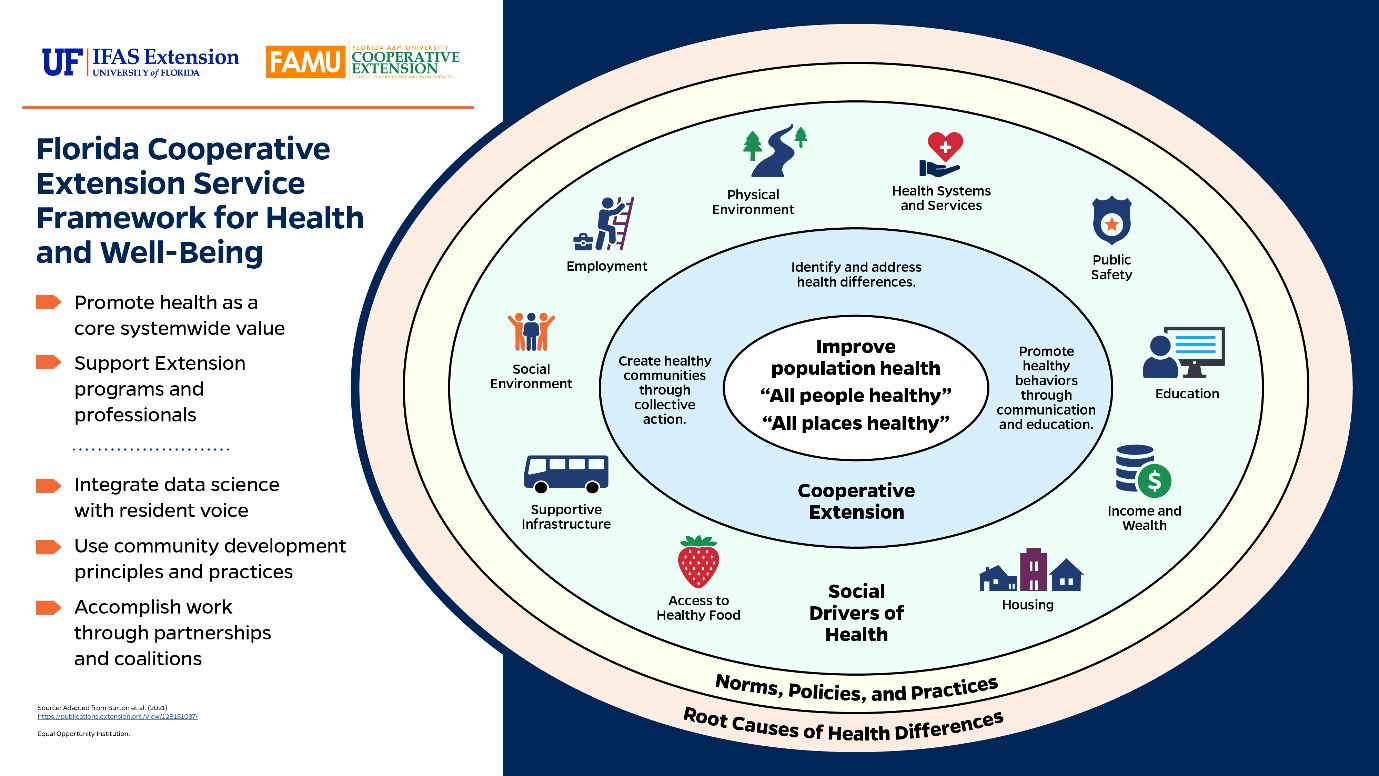
Credit: UF/IFAS Communications.
Overview of the Framework
The Florida Cooperative Extension Service Framework for Health and Well-Being provides the blueprint for achieving the dual goals outlined in the national framework: to improve population health by ensuring “all people are healthy” and “all places are healthy.” As outlined in the second ring (from center), Cooperative Extension professionals must adopt new strategies and continue established strategies for addressing health differences that impact health issues for many Floridians.
The first strategy, identifying and addressing health differences, recognizes that some individuals, groups, and communities are at a higher risk for adverse health outcomes. A hallmark of Extension is continuously assessing community needs and developing strategies to address them. However, universal interventions and educational programs, such as promoting healthy eating, assume that healthy foods are available to all people. Tailoring interventions to the unique needs of local communities might include efforts designed to promote healthy eating while helping to address access to healthy food. The second strategy is the core of Cooperative Extension: promoting healthy behaviors through communication and education. This strategy may focus on the general population or those at higher risk for adverse health outcomes. Utilizing both strategies is ideal for improving population health and advancing health for all people and all places. Building healthy communities through collective action is the final and most important strategy for achieving the two goals. Collective action approaches, such as working with coalitions to reduce barriers to achieving optimal health, create healthier communities that allow all Floridians to become the healthiest version of themselves.
The third ring of the framework identifies modifiable risk factors, also known as social drivers of health, associated with poor health outcomes for individuals and communities. While much of the work Cooperative Extension does with Floridians centers around providing education, research has found that health behaviors, such as diet and exercise, account for only 30% of health outcomes. Social drivers of health — non-medical factors including economic stability, family and social support, availability of clinical care, and the physical environment — have been found to account for 70% of health outcomes (The University of Wisconsin Population Health Institute, 2025). Thus, health promotion efforts may have limited impact without collective efforts across multiple sectors to create healthier communities.
The ten social drivers of health in the framework provide context for working collectively with community collaborators to improve health outcomes. Cooperative Extension professionals help translate knowledge into solutions to sustain and enhance the health and well-being of Floridians. For example, to address individual housing concerns, we host workshops and classes on homeownership, healthy homes, budgeting, and credit repair. To address housing, we collaborate with community members and community organizations to identify pertinent housing issues and work collectively on solutions.
In sum, while education and communication have been primary Cooperative Extension strategies for serving Floridians, current research points out the need for community change in addition to individual knowledge. Collective action allows us to combine our expertise in health promotion and non-medical factors with our collaborators’ expertise in social norms, local institutions, community strengths, and local policies (fourth ring of the framework) to create healthier communities. By working together, we can identify and address the root causes of health differences (fifth ring of the framework).
There are five high-level recommendations for Florida Cooperative Extension to guide our approach.
- Promote health as a core systemwide value.
- Support Extension programs and professionals.
- Integrate data science with resident voice.
- Use community development principles and practices.
- Accomplish work through partnerships and coalitions.
The first two recommendations are led by Extension leadership. In alignment, health is being promoted as a core systemwide value in Florida. This is evident in the Florida Cooperative Extension: Pathway to Creating Engagement Through Innovation & Excellence, which sets the strategic direction for Extension through 2029. Specifically, Initiative 5 focuses on improving individual, family, and community health, and is being led by the Family and Consumer Sciences program area. The Florida Cooperative Extension Service Framework for Health and Well-Being is the theoretical framework underlying this initiative. Advancing this work will involve investing in organizational resources to support Extension programs and faculty who are working to improve individual and community health. Extension faculty accomplish the final three recommendations through their work with local communities.
Summary
The Florida Cooperative Extension Service Framework for Health and Well-Being serves as Florida’s model for improving population-level health. The Family and Consumer Sciences program area is leading the charge to improve population-level health in alignment with Florida Cooperative Extension’s new strategic direction. The refocusing of Family and Consumer Sciences in this direction builds off our collective strengths and breadth of expertise, uniquely positioning Florida as a leader in the country in advancing national health priorities. The health and well-being of Floridians is essential for a thriving workforce and economy. We have the important role of working with individuals and communities to ensure all Floridians can achieve optimal health.
References
Braun, B., Bruns, K., Cronk, L., Fox, L. K., Koukel, S., Le Menestrel, S., Lord, L. M., Reeves, C., Rennekamp, R., Rice, C., Rodgers, M., Samuel, J., Vail, A., & Warren, T. (2014). Cooperative Extension’s National Framework for Health and Wellness. Report of the Health Task Force. Washington, D.C.: Extension Committee on Organization and Policy. Retrieved from https://www.aplu.org/wp-content/uploads/national-framework-for-health-and-wellness.pdf
Burton, D., Canto, A., Coon, A., Eschbach, C., Gutter, M., Jones, M., Kennedy, L., Martin, K., Mitchell, A., O’Neal, L., Rennekamp, R., Rodgers, M., Stluka, S., Trautman, K., Yelland, E., & York, D. S. (2021). Cooperative Extension’s National Framework for Health Equity and Well-Being. Report of the Health Innovation Task Force. Washington, D.C.: Extension Committee on Organization and Policy. Retrieved from https://publications.extension.org/view/128151037/32/
Leidenfrost, N. B. (2000). EFNEP's Beginning and the First 20 Years: A Historical Perspective. Journal of Family and Consumer Sciences, 92(1), 37–44. Retrieved from https://login.lp.hscl.ufl.edu/login?url=https://www.proquest.com/scholarly-journals/efneps-beginning-first-20-years-historical/docview/218178380/se-2
The University of Wisconsin Population Health Institute. (2025). County Health Rankings & Roadmaps Model of Health, 2025. Retrieved March 24, 2025, from www.countyhealthrankings.org