
Angular leaf spot (ALS) is a bacterial disease caused by Xanthomonas fragariae, a pathogen highly specific to wild and cultivated strawberry, Fragaria x ananassa.
ALS is an important disease on winter-produced strawberry worldwide and is considered a quarantine disease by the European Union. The disease was reported first in the United States in Minnesota in 1960; since then, it has been found in almost all cultivated strawberry areas in the country, including Florida. In California, the largest US producer of fresh strawberries, ALS is a minor disease that occurs especially during rainy weather or when overhead sprinkler irrigation is used. Although the disease is considered minor in California's fruit production fields, it is a problem for nurseries that export plants to Europe and other countries with quarantine restrictions.
In Florida, ALS is the primary strawberry disease caused by a bacterium.
Pathogen and Symptoms
Xanthomonas fragariae, the causal agent of ALS, is a slow-growing, gram-negative bacterium that produces water-soaked lesions on the lower leaf surfaces (Figure 1). The bacteria enter the leaf through the stomata (tiny pores that are most abundant on the lower surface of the leaf). Lesions begin as small and irregular spots on the undersurface of the leaflets. When moisture is high on the leaves, lesions ooze sticky droplets of bacteria. As the disease develops, lesions enlarge and coalesce to form reddish-brown spots, which later become necrotic (Figure 2).
A practical way to recognize the disease is to place the leaves against a source of light where the translucent spots can be seen (Figure 3). The tissue with older damage eventually dies and dries up, giving leaves a ragged appearance.
During severe epidemics, the pathogen can also cause lesions on the calyx of fruit. This symptom on the calyx is known as brown cap, and the lesions are identical to those on the leaves (Figure 4). When severe, these calyxes can dry up, rendering the fruit unmarketable.
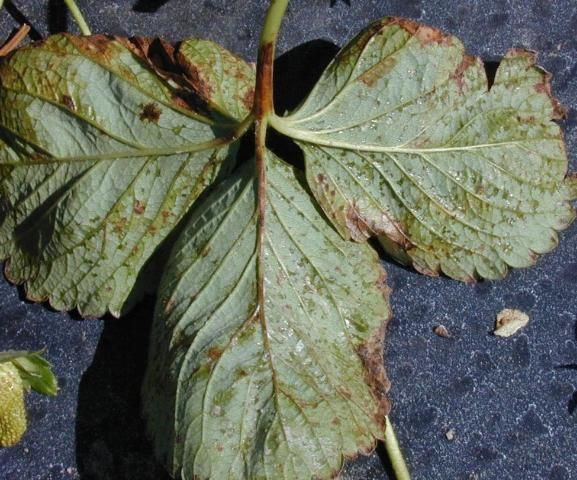
Credit: UF/IFAS GCREC
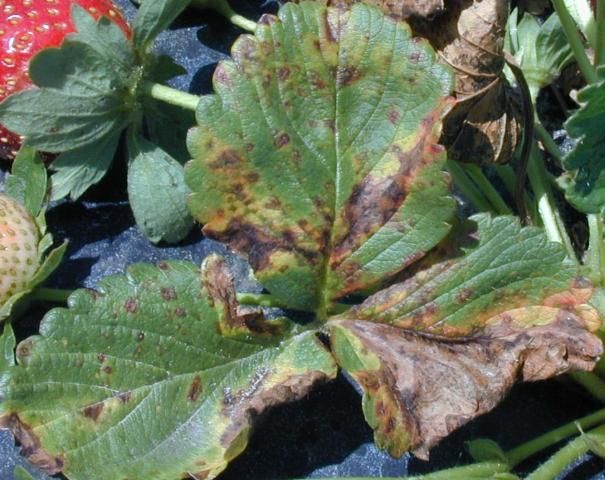
Credit: UF/IFAS GCREC
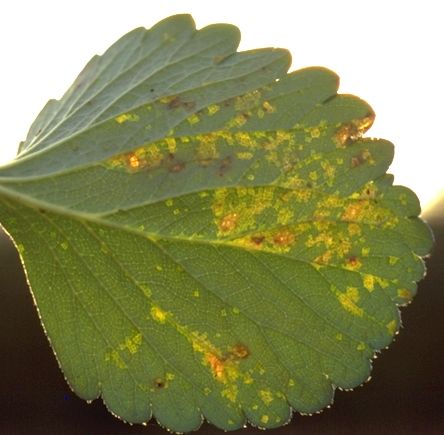
Credit: UF/IFAS GCREC
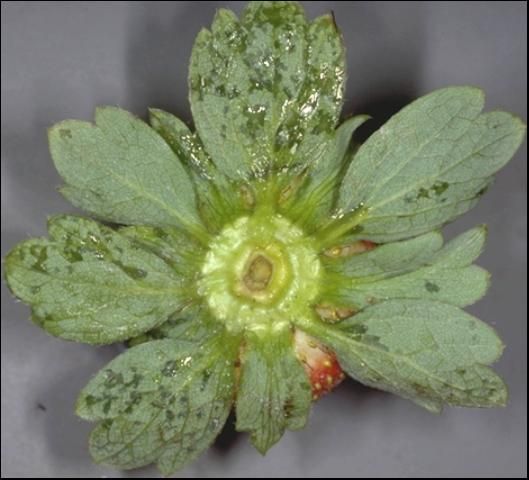
Credit: UF/IFAS GCREC
Disease Development and Spread
The primary source of inoculum in a new field is contaminated transplants. Secondary inoculum comes from bacteria that exude from lesions under high moisture conditions. Bacteria can survive on dry infested leaves and tissue buried in the soil for up to one year.
The pathogen is mainly dispersed by rain and overhead sprinkler irrigation, and thus the disease is especially problematic during seasons when overhead irrigation is used many times for freeze protection. The bacteria can also be spread easily by harvesting and handling operations when wet and cool conditions favor the production of bacterial exudate.
Control
Limited control options exist when infected transplants are planted in Florida production fields. Host resistance is not a viable option to manage ALS since all cultivars grown in Florida are susceptible to the disease.
The best way to control ALS is to use pathogen-free transplants. Since this is not always possible, the use of overhead sprinklers during plant establishment and freeze protection should be minimized to reduce the spread of the disease. Protective structures, such as high plastic tunnels, could serve as an alternative to using water for freeze protection. In strawberry production areas where tunnels are used, the disease is usually not a problem.
Growers should avoid moving equipment through the field when plants are wet, and harvesting and handling operations of infested fields should be done after non-infested fields to minimize dissemination.
Studies conducted at GCREC have shown that frequent use of some organosilicon and non-ionic surfactants as spray adjuvants can increase ALS incidence and reduce crop yield. These products often help bacteria penetrate through the stomata and thus have been shown to enhance disease development.
Copper-based products can provide effective control of the disease in some instances; however, low rates of copper should be used as phytotoxicity (reddening of older leaves, slow plant growth, and yield reduction) has been documented with repeated sprays. Several copper materials are labeled for ALS control on strawberry, such as copper hydroxide, copper oxychloride, basic copper sulfate, cuprous oxide, and various other copper compounds. All of these active ingredients suppress ALS, but they should be applied preventively at low rates. Our trials have shown that preventive, weekly applications of copper fungicides at 0.3 lb of metallic copper per acre were effective in reducing disease symptoms without phytotoxicity to the plants. However, when disease pressure is low to moderate, the use of copper sprays did not significantly increase yield. Copper products only increased yield and reduced unmarketable fruit when environmental conditions were highly favorable for infection and dissemination.
Many other products have been tested over the years in the search for alternatives to copper.
Actigard®, a plant-resistance activator manufactured by Syngenta, has been found to suppress ALS in our trials and is now approved for use on strawberry in Florida. As with copper, Actigard® should be applied preventively and at the lowest label rate since higher rates have been shown to be detrimental to yields.