
This document is best viewed as a pdf.
Front: Fungicide table
Credit: UF/IFAS
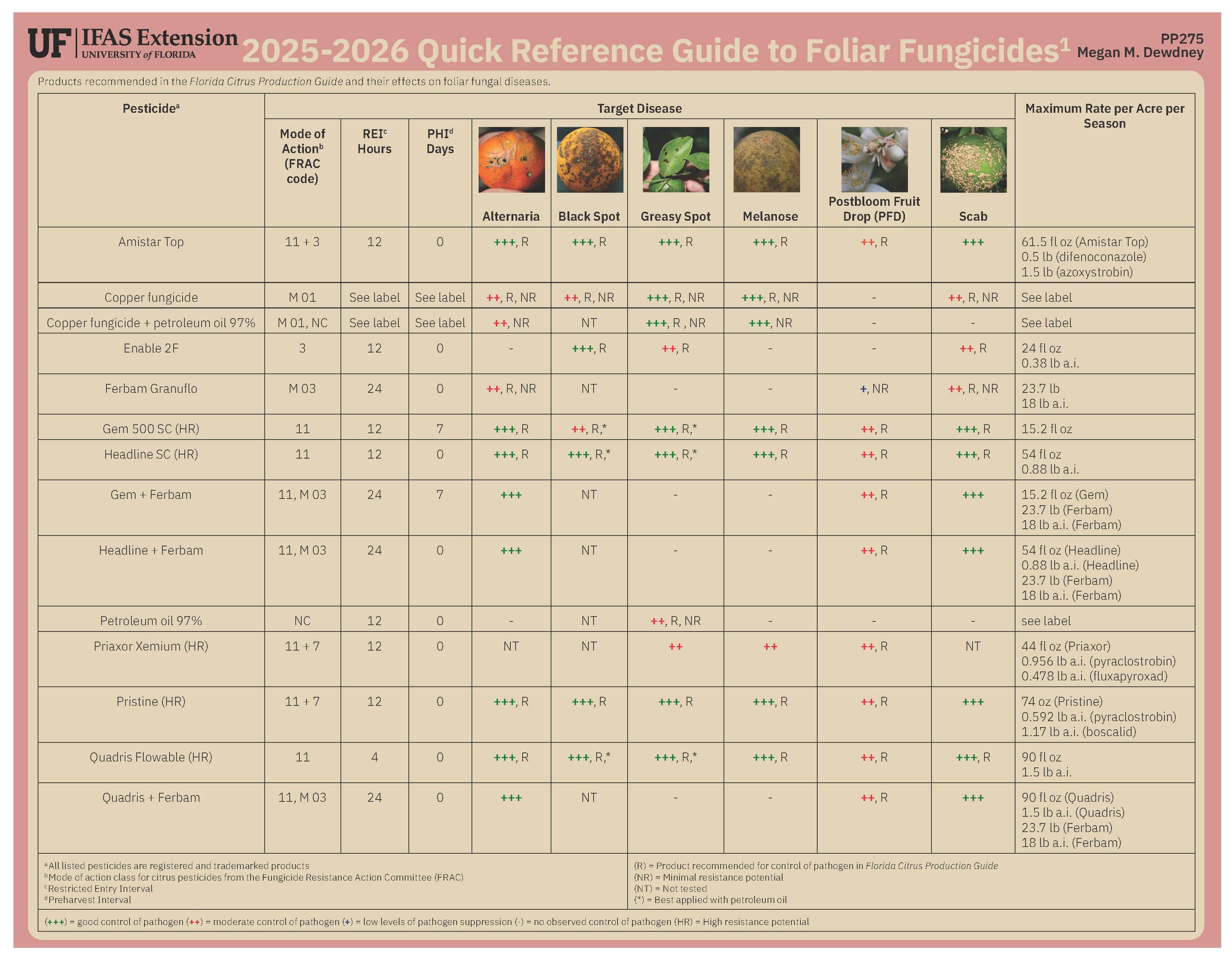
This reference guide provides quick access to foliar fungicide recommendations from the Florida Citrus Production Guide. Also included are guidelines for fungicide resistance management.
Table 1. Products recommended in the Florida Citrus Production Guide and their effects on foliar fungal diseases.
a All listed pesticides are registered and trademarked products
b Mode of action class for citrus pesticides from the Fungicide Resistance Action Committee (FRAC)
c Restricted Entry Interval
d Preharvest Interval
(R) = Product recommended for control of pathogen in Florida Citrus Production Guide
(NR) = Minimal resistance potential
(NT) = Not tested
(*) = Best applied with petroleum oil
(+++) = good control of pathogen (++) = moderate control of pathogen (+) = low levels of pathogen suppression (-) = no observed control of pathogen (HR) = High resistance potential
Back: Fungicide Resistance Management
Credit: UF/IFAS
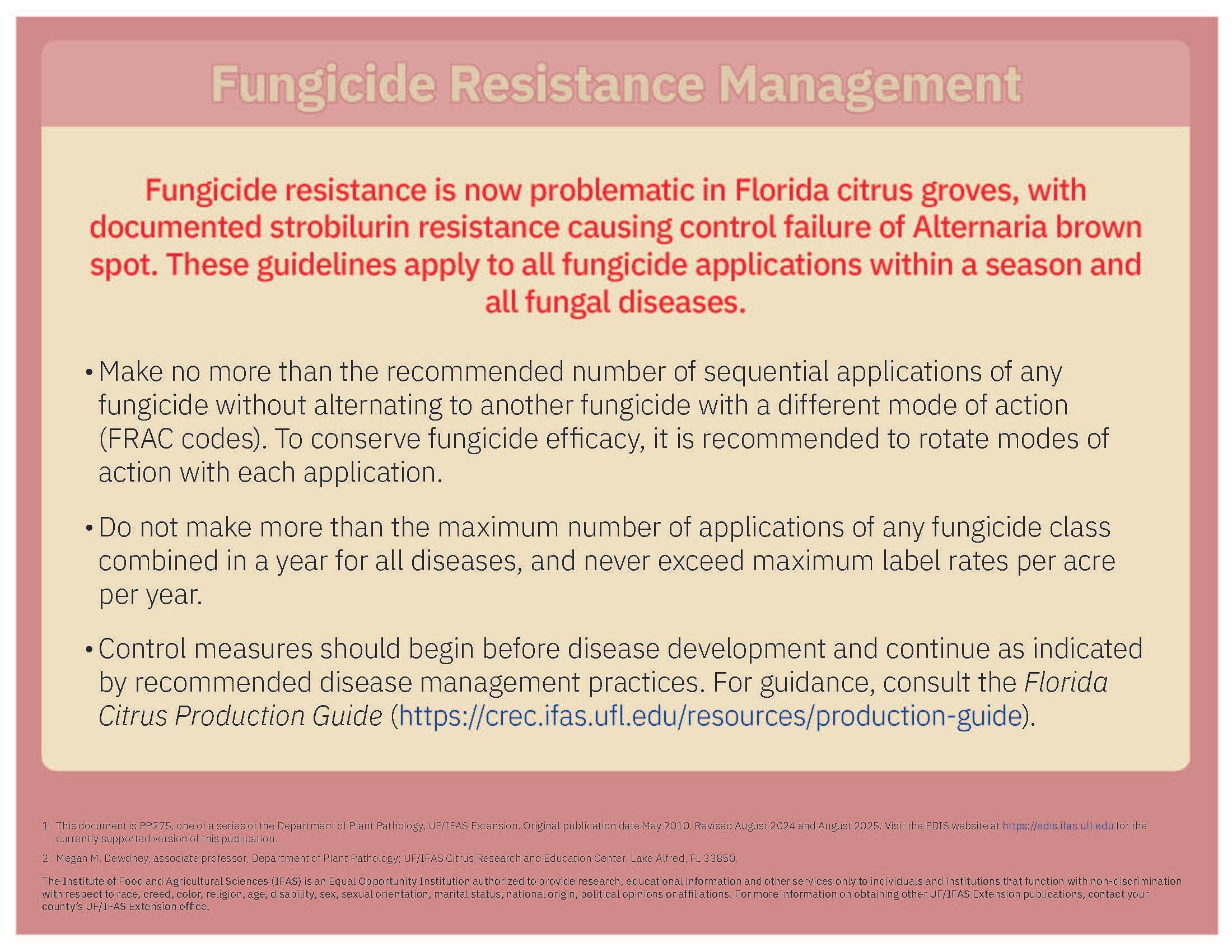
Fungicide resistance is now problematic in Florida citrus groves, with documented strobilurin resistance causing control failure of Alternaria brown spot. These guidelines apply to all fungicide applications within a season and all fungal diseases.
- Make no more than the recommended number of sequential applications of any fungicide without alternating to another fungicide with a different mode of action (FRAC codes). To conserve fungicide efficacy, it is recommended to rotate modes of action with each application.
- Do not make more than the maximum number of applications of any fungicide class combined in a year for all diseases, and never exceed maximum label rates per acre per year.
- Control measures should begin before disease development and continue as indicated by recommended disease management practices. For guidance, consult the Florida Citrus Production Guide (http://www.crec.ifas.ufl.edu/resources/production-guide).