
Introduction
Pestalotiopsis-like fungi cause diseases on many different species of plants worldwide, including strawberry. The pathogen is not new to strawberry and was first reported causing fruit rot in Florida and Israel in the 1970s. In the last decade, the fungus was associated with root and crown rots in Florida and other strawberry-producing areas. During the 2018–19 and 2019–20 strawberry seasons, severe and unprecedented outbreaks were reported in Florida, characterized by symptoms on nearly all plant parts, including fruit and leaves (Figure 1). Yield was severely affected, and in several cases, entire fields were rendered uneconomical to harvest and destroyed. The common link among these outbreaks was the nursery source of the transplants. Unfortunately, most of the commercial strawberry cultivars grown in Florida are susceptible, and currently there are no fungicides labeled to control this disease in the United States or elsewhere. This publication describes the disease and its causal agent and briefly covers what is known about disease development and control practices. This document will provide valuable information to strawberry nursery and fruit production growers.
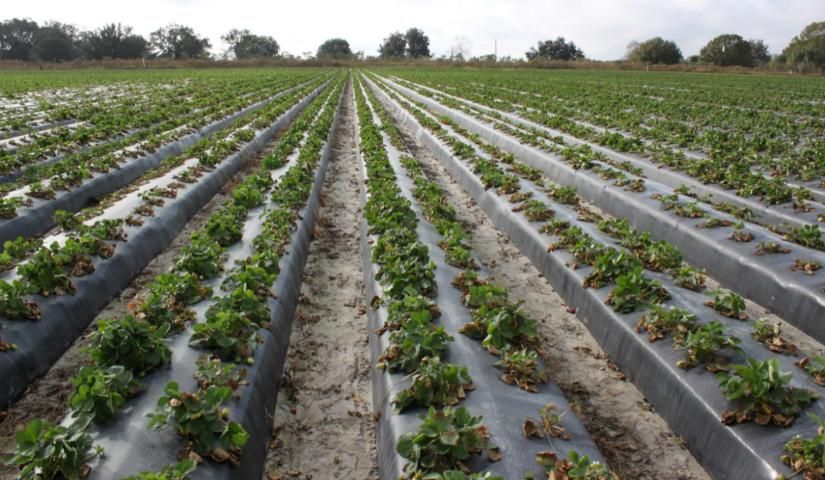
Credit: UF/IFAS GCREC
Causal Agent and Symptoms
The taxonomy of this pathogen is confusing because it has gone through multiple reclassifications over the years. Researchers in Florida and Israel reported it for the first time on strawberry as Pestalotia longisetula. These reports characterized it mainly as a fruit rot pathogen. Based on spore type and other morphological characteristics, the pathogen was subsequently reclassified as Pestalotiopsis longisetula. More recently, strawberry isolates were identified as Neopestalotiopsis spp. in reports describing a pathogen of strawberry roots and crowns. According to the most recent studies, isolates reported in the past as Pestalotiopsis longisetula are now classified as Neopestalotiopsis rosae. These isolates are most commonly found causing symptoms on roots and crowns during plant establishment. Belowground symptoms are characterized by darkening of the roots and orange-brown necrosis in the crowns, which contribute to stunting or poor establishment after transplanting. Aboveground symptoms range from stunting and wilting to eventual collapse of the entire plant (Figure 2). In some cases, the fungus is isolated along with other root and crown pathogens such as Macrophomina phaseolina, as well as Colletotrichum and Phytophthora species. The fungus has always been considered a weak or secondary pathogen and was never a major concern in the strawberry industry until recently.
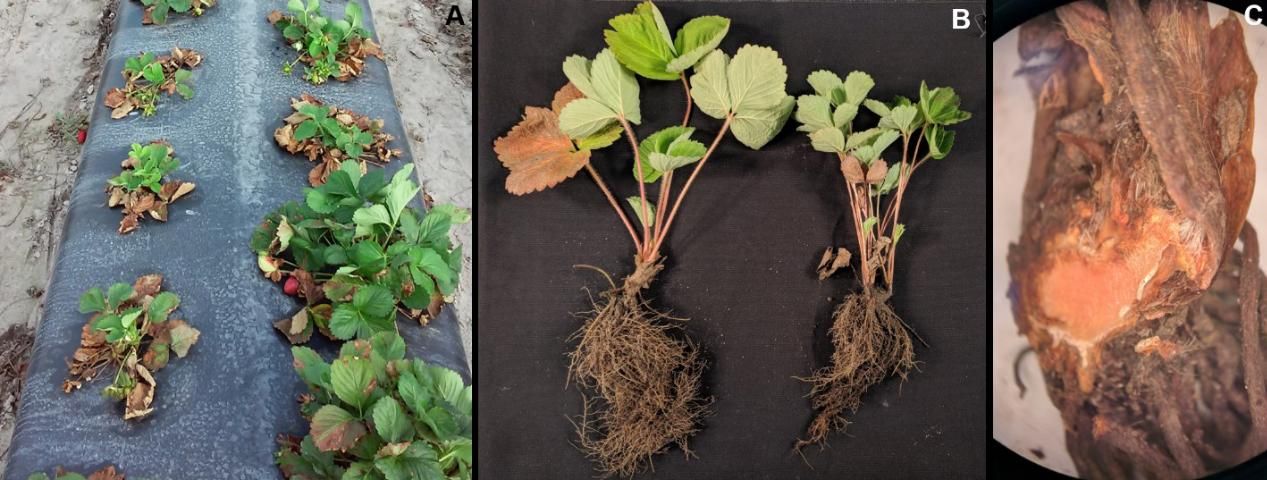
Credit: UF/IFAS GCREC
Studies performed at the UF/IFAS Gulf Coast Research and Education Center (GCREC) in Wimauma, FL, indicate that isolates from recent outbreaks are more aggressive and may belong to a new, heretofore-unnamed Neopestalotiopsis species. In the recent outbreaks, leaves and fruit were infected early, and some were severely damaged. As the disease progresses, the pathogen can also be isolated from diseased petioles, crowns, and roots. Fruit symptoms can be confused with anthracnose fruit rot (Figure 3). More information about anthracnose fruit rot can be found at https://edis.ifas.ufl.edu/pp130. Leaf spots initially can be confused with other fungal diseases such as leaf blotch (Gnomonia comari), Phomopsis leaf blight (Phomopsis obscurans), common leaf spot (Mycosphaerella fragariae), Cercospora leaf spot (Cercorspora fragariae), and leaf scorch (Diplocarpon earliane). Thus, accurate diagnosis is extremely important, because disease management practices may differ.
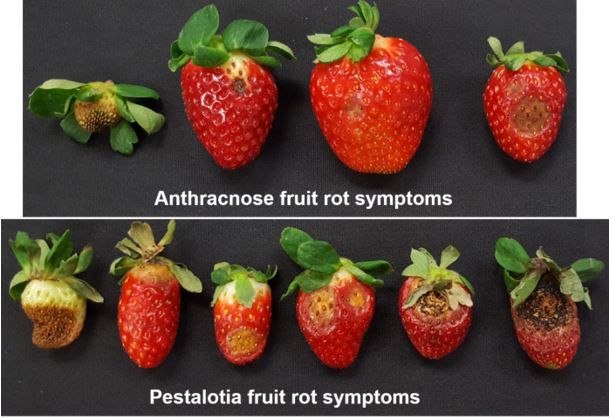
Credit: UF/IFAS GCREC
Young fruit spots are 2–4 mm in diameter, dry, light tan, slightly sunken, and irregular in shape. Lesions grow in size and eventually are covered by dark fruiting bodies (acervuli), which exude spores into shiny black liquid matrix droplets (Figures 3 and 4).
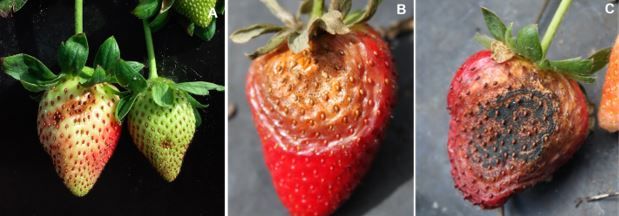
Credit: UF/IFAS GCREC
Light- to dark-brown spots of different sizes are irregularly distributed on infected leaves. In more advanced stages, the spots increase in size, and although many are roughly circular, some become irregular upon reaching the leaf margins. Dark fruiting bodies (acervuli) containing the fungal spores develop in the tan centers of older necrotic tissues (Figure 5).
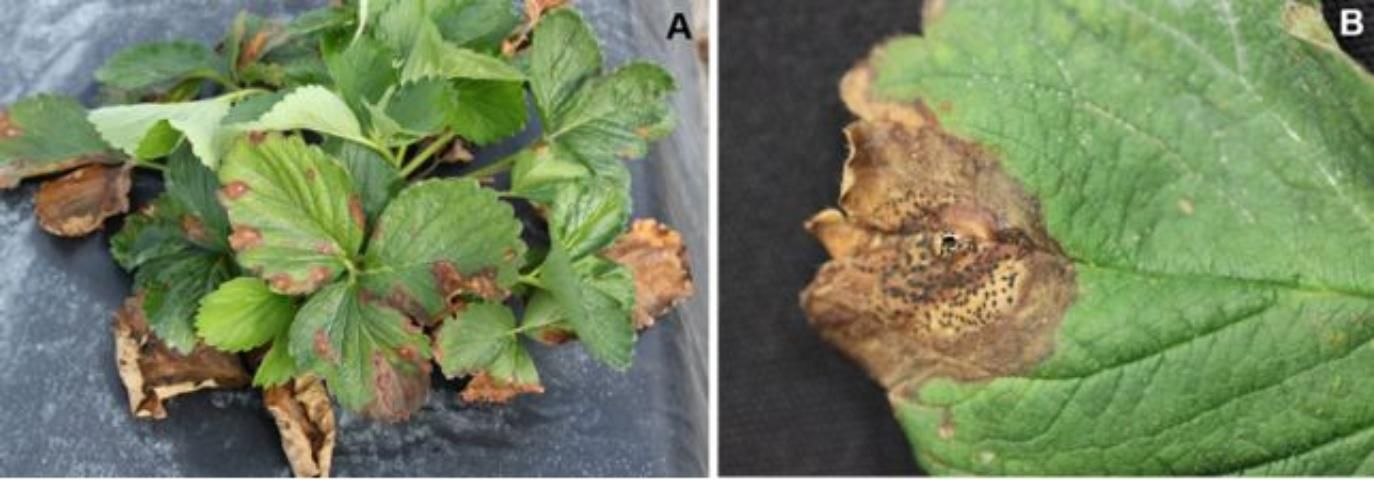
Credit: UF/IFAS GCREC
Spores are exuded in black droplets as described for fruit lesions, and also in dark sooty columns when relative humidity is high (Figure 6). Mass spotting often produces blight-like necrosis of broad areas of the leaf, eventually killing it. The disease can also contribute to poor development of the plants, which become stunted with smaller, weaker leaves. The pathogen eventually infects roots and crowns, producing belowground symptoms as previously described.
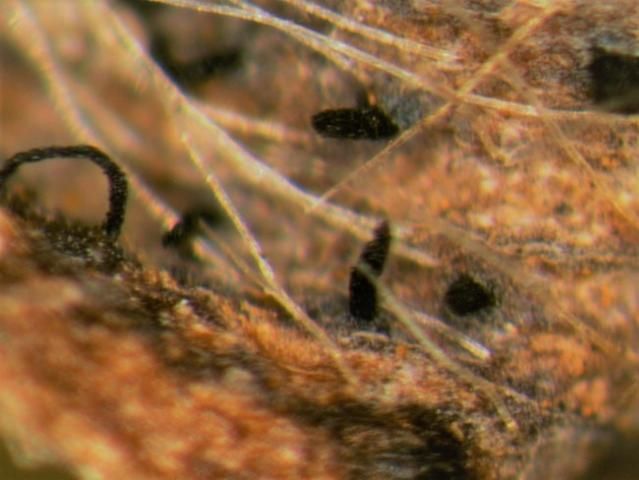
Credit: James Mertely, UF/IFAS GCREC
Disease Development and Spread
Our studies suggest that the primary source of inoculum for epidemics in Florida is infected strawberry transplants from specific nurseries. However, the pathogen can spread to other fields locally. The disease is generally favored by consecutive and prolonged rain events, and by temperatures above 50°F (10°C), with an optimum between 77°F and 86°F (25°C and 30°C). The fungus produces spores on the surface of infected tissues that can be spread by water, farm equipment, and field workers during harvest and cleaning operations. Under favorable conditions, the pathogen spreads very rapidly. A recent study has shown that the fungus can also survive in our soils for up to 17 months, highlighting its persistence between seasons and another potential inoculum source.
Control
Management of Neopestalotiopsis involves a combination of cultural practices and chemical strategies. Further studies are needed to develop integrated strategies for disease management in strawberry nursery and production fields.
Cultural
Acquiring disease-free transplants, when possible, is the best practice to avoid the introduction of the pathogen in a field and escape or delay the occurrence of the disease. However, symptoms are not always easily recognized on transplants after their arrival in Florida, and thus routine inspections at the nursery level should be implemented.
Limiting field operations such as harvesting and spraying when plants are wet is important to minimize dispersal within and between fields. Spread can be minimized by hand sanitation, cleaning and disinfestation of equipment, and performing farm operations in affected fields at the end of the day.
All currently commercially grown cultivars are susceptible to the disease. 'Florida Beauty' and 'Florida Brilliance' are the most susceptible, whereas Sweet Sensation® 'Florida127', ‘Florida Medallion’ and ‘Florida Encore’ show intermediate susceptibility. Recently released ‘Florida Ember’ and the Pearl white cultivars tend to show lower levels of disease but are still affected.
Chemical
Although there are no fungicides currently labeled for the control of Neopestalotiopsis on strawberry, screening studies and/or field trials at UF/IFAS GCREC showed that Switch® 62.5 WG (fludioxonil + cyprodinil) and Thiram SC (thiram) were the most effective in controlling the pathogen. Bravo Weather Stik® (chlorothalonil), Omega® (fluazinam), Captan and some DMI fungicides such as Rhyme (flutriafol) and Inspire (difenoconazole) also offered some degree of disease control. Bravo and Omega® are not registered for strawberry production fields but could be good options for strawberry nurseries. Some commercial brands containing chlorothalonil are already registered for nursery use and Omega® is in the process of registration. Our industry greatly relies on fludioxonil (one of the active ingredients in Switch® and Miravis® Prime) for the control of other diseases, such as Botrytis and Anthracnose fruit rots. The overuse of these products can lead to increased selection for fungicide resistance. Therefore, disease management should primarily rely on applications of multi-site products such as Thiram and Captan and limit applications of single-site materials such as Switch and Miravis Prime to rainy periods when weather is conducive for disease development, and it should always follow the maximum number allowed on the label. Isolates of the new Neopestalotiopsis have already been found to have resistance to the strobilurin fungicides (Abound, Cabrio, Flint, etc.). Effective alternative products are greatly needed and currently being researched.
Additional Information
More information on products for sanitation of equipment and tools is available at https://edis.ifas.ufl.edu/fs077 and https://doi.org/10.32473/edis-fs366-2020.
References
Baggio, J. S., B. B. Forcelini, N.-Y. Wang, R. G. Ruschel, J. C. Mertely, and N. A. Peres. 2020. "Outbreak of Leaf Spot and Fruit Rot in Florida Strawberry Caused by Neopestalotiopsis spp." Plant Disease, First Look. https://doi.org/10.1094/PDIS-06-20-1290-RE
Chamorro, M. C., A. Aguado, and B. De los Santos. 2016. "First Report of Root and Crown Rot Caused by Pestalotiopsis clavispora (Neopestalotiopsis clavispora) on Strawberry in Spain." Plant Dis. 100:1495.
Howard, C. M., and E. E. Albregts. 1973. "A Strawberry Fruit Rot Caused by Pestalotia longisetula." Phytopathology 63:862–863.
Kenneth, R. G., R. Barkai-Golan, and D. Netzer. 1968. "A Pestalotia Fruit Rot of Strawberry in Israel." Plant Dis. Rep. 52:472–474.
Obregón, V. G., N. G. Meneguzzi, J. M. Ibañez, E. Lattar, and D. S. Kirschbaum. 2018. "First Report of Neopestalotiopsis clavispora Causing Root and Crown Rot on Strawberry Plants in Argentina." Plant Dis. 102:1856.
Steyaert, R. L. 1955. "Pestalotia, Pestalotiopsis et Truncatella." Bulletin Jardin Botanique État Bruxelles 25:191–199.