
This guide recommends possible pesticide spray programs that may help to manage watermelon diseases in the state of Florida.
Management Considerations
- Follow a three-to-five-year non-cucurbit crop rotation to reduce disease. Fields with a Fusarium wilt history should use non-host rotations of more than five years. Avoid double-cropping cucurbit crops using the same plastic, as this can lead to significant disease issues in the right environments.
- Inspect transplants. Healthy transplants are critical to managing gummy stem blight, Fusarium wilt, and bacterial diseases, since these diseases can be spread by seed. Inspecting transplants and removing diseased seedlings, including symptomless plants surrounding them, will reduce risk.
- Spray early and consistently to efficiently manage disease. Fungicides are more effective when applied preventatively than as a cure.
- Rotate fungicide chemistries to minimize the risk of selecting for resistant fungal pathogens. The Fungicide Resistance Action Committee (FRAC) has developed a number and letter code that classifies fungicides’ modes of action. Rotating different modes of action is an important step in prolonging a fungicide’s effectiveness.
- Select fungicides based on the target pathogen. Many fungicides can control multiple diseases, but in general, they are most effective for specific pathogens. Accurate diagnostics are important when selecting proper fungicide products or developing a management plan.
Common Diseases
Powdery mildew (PM) typically produces white, powder-like signs on the upper and lower surfaces of watermelon leaves. This disease starts as small, faint, yellowish spots on the leaves that spread to neighboring leaf surfaces. Dry conditions facilitate PM spread; however, infection requires the presence of moisture. Symptoms first appear in the lower canopy on older leaves and can quickly spread throughout a field. PM resistance to fungicides in FRAC groups 1 (e.g., Topsin M), 3 (e.g., tebuconazole), 7 (e.g., boscalid), and 11 (e.g., azoxystrobin) has been identified. Fungicide options for PM are Vivando, Quintec, Rally, Switch, Luna Experience, and Torino; however, there are indications of Torino having reduced efficacy against some PM isolates.
Downy mildew (DM) is a continual cucurbit problem in the southern Florida peninsula, while its incidence varies from year to year in the northern half of the state. Lesions start out as yellow angular leaf spots that later turn brown to black in color. Leaf curling and water-soaking are often associated with DM. A white-to-grayish fungal growth will appear on the undersides of leaves displaying these lesions when the leaves are wet from heavy dews, rainfall, and high humidity (> 90%). Protectant fungicides (e.g., chlorothalonil and mancozeb) provide excellent control early in the season, but their effectiveness is limited once DM develops. DM has been reported to have resistance to Ridomil, Revus, Forum, and FRAC group 11 fungicides (e.g., Cabrio, Quadris). Once DM is present, some strong fungicide options are Orondis Ultra and Ranman; however, other good early season options are available. These fungicides should be mixed with a protectant fungicide to provide optimal control.
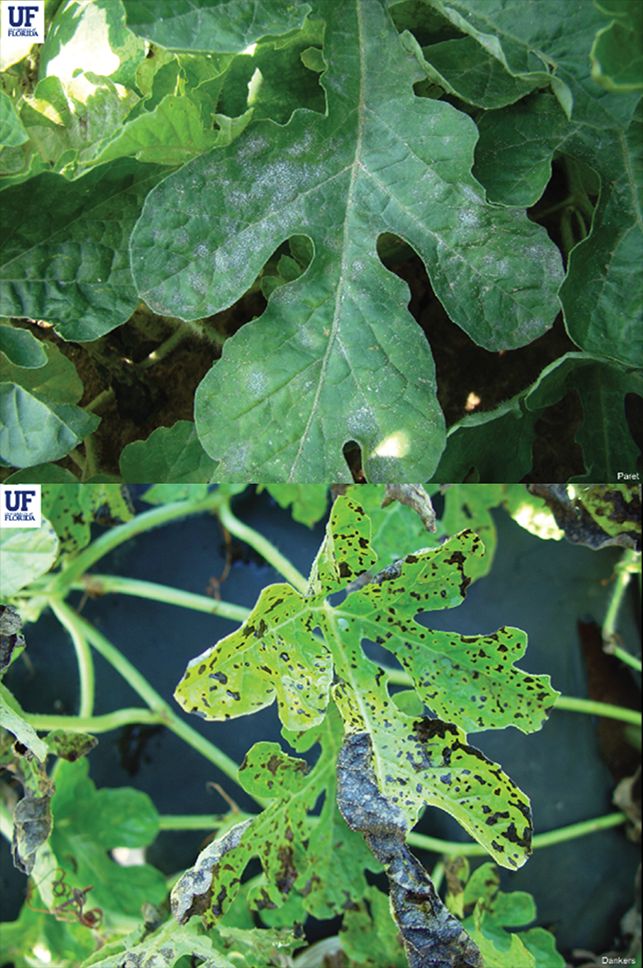
Credit: Mathews Paret (top), UF/IFAS; and Hank Dankers (bottom), formerly UF/IFAS
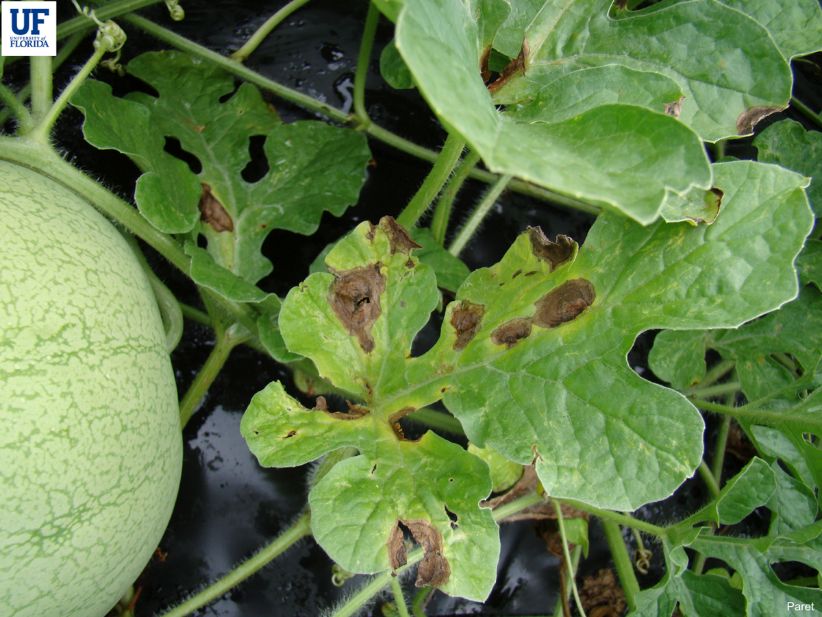
Credit: Mathews Paret, UF/IFAS
Gummy stem blight (GSB)’s primary symptom is dark circular leaf spots at the margins of the leaf surface. When severely infected, complete leaf necrosis and leaf drop are common. If a severe outbreak happens with heavy leaf drop before fruit set, yield losses can be substantial as exposed fruits experience sun-scalding. The GSB pathogen is known to be resistant to multiple fungicides; hence, a carefully planned fungicide rotation program is necessary to reduce fungicide failure. Fungicides in FRAC groups 11 (e.g., Quadris), 1 (e.g., Topsin-M), and 7 (e.g., Endura) have a high risk of failure. The recommended GSB fungicide rotation programs are FRAC group M5 (e.g., chlorothalonil) with group 3 (e.g., tebuconazole) or premixes (e.g., Inspire Super, Luna Experience, Aprovia Top, Miravis Prime).
Bacterial diseases: Bacterial fruit blotch (BFB) symptoms appear as dark greasy spots on the fruit and irregular spots on the leaves. The foliar application of FRAC group M1 (copper-based compounds) or group P (Actigard) fungicides can manage the disease. Copper-based compounds should be applied two weeks before female flowers open, at bloom, and two weeks after bloom. This will help in the suppression of BFB and other bacterial diseases, including bacterial leaf spot/angular leaf spot. Actigard should also be applied early in the season and before the start of the infection to be effective. These strategies, coupled with maintaining healthy transplants, will ensure that bacterial diseases are effectively managed early in the season, which is the critical infection period.
Fusarium wilt (FW) causes vine wilting and decline. Symptoms are often more pronounced on one side of the plant. Older leaves wilt first during the day and recover at night. Vascular discoloration can be seen when the stem is split. Due to the soilborne nature of FW, few fungicides are effective for control. Prothioconazole (Proline 480 SC) or pydiflumetofen (Miravis Prime) can suppress this disease. Please see fungicide label information for application instructions specific to Fusarium wilt.
Spray Schedules
A typical spring spray schedule in Florida should start one week after transplanting and then use a 7-to-10-day schedule. These schedules should be shortened to 5 to 7 days during prolonged rainfall periods and should only be greater than 10 days if it is very dry and no disease is present. Preharvest intervals (PHI) for late season sprays may be as high as 14 days, requiring attentive planning. Chlorothalonil is a quality early season disease control product but should not be sprayed within 21 days of harvest as it can cause watermelon rind burn.
A typical fall spray schedule follows a program similar to that of spring. However, heavy rains often occur in the fall with cooler temperatures occurring late in the season, so additional products should be applied with or in replacement of chlorothalonil in sprays two and three. Some example products include Orondis Ultra for downy mildew and Luna Experience for gummy stem blight. Caution: Recent years have seen many viruses emerge, thus there is a high risk for crop failure in growing fall watermelon.
Consult the Vegetable Production Handbook of Florida for more detailed information.
Table 1. Suggested Seasonal Spray* Schedules Recommended for Watermelon Production Based on Data from 2012 to 2024.