
Introduction
Maintaining the health of lawns requires proper turf care, particularly in regions where diseases and periodic drought are common. Florida is unique because of its high precipitation but very low water-holding capacity of its prevalent sandy soils, which adds an extra layer of difficulty to irrigation. As a result of this, lawns are often overwatered but may face underwatering during the dry season. The resilience and overall health of turfgrass can be jeopardized by improper irrigation. This guide is meant to inform homeowners and landscape personnel about common mistakes to avoid and the importance of using appropriate watering procedures when irrigating turfgrass to further promote the vitality of lawns.
While following guidelines in this publication, be sure to also adhere to any watering ordinances, fertilizer black-out days, and water restrictions in your area.
The Importance of Proper Irrigation Techniques
A key component of turfgrass management is irrigation, especially in Florida where daily evapotranspiration may exceed the water held in the soil. Using proper watering techniques will help conserve water while simultaneously maintaining the vigor and overall aesthetic appeal of your turf. Numerous issues can manifest when improper irrigation scheduling, such as overwatering or underwatering, is conducted. This portion of this guide will detail the three primary problems that emerge from improper watering habits. These are shallow root growth, disease, and leaching/depletion of nutrients.
1. Shallow Root Growth
Shallow roots may develop due to improper irrigation practices, such as overwatering or regular occurrences of shallow watering. Shallow watering refers to the practice of frequently irrigating (i.e., every day or 3 or 4 times a week) with small quantities of water. This only moistens the soil surface, fails to reach deeper root zones, and encourages root development close to the surface. Shallow roots make the turfgrass more susceptible to drought, but hardier, drought-resistant lawns can be developed by irrigating less frequently and more deeply. Soil probes are the easiest way to determine soil moisture at this depth, but you can also use a long screwdriver to determine this. To perform this soil probe test, you will thoroughly irrigate the lawn, use the probe/screwdriver to penetrate the soil, and confirm your probe/screwdriver can easily be driven down 6–8 inches. This is a good sign of adequate soil moisture; if you meet resistance, more irrigation is likely needed. Remember that watering established lawns in Florida every day is unnecessary.
2. Disease
Large patch (previously known as brown patch) (Pathogen: Rhizoctonia solani): A fungal disease that is most commonly spotted in November to May, particularly in St. Augustinegrass and zoysiagrass (Figure 1). This infection starts in the leaf area closest to the soil and kills the leaf after forming a soft, dark rot at its base. The chance of this occurring is increased when the roots are not deep enough to support healthy grass during drought conditions (Elliott and Harmon 2018). More information on large patch can be found at https://edis.ifas.ufl.edu/publication/LH044.
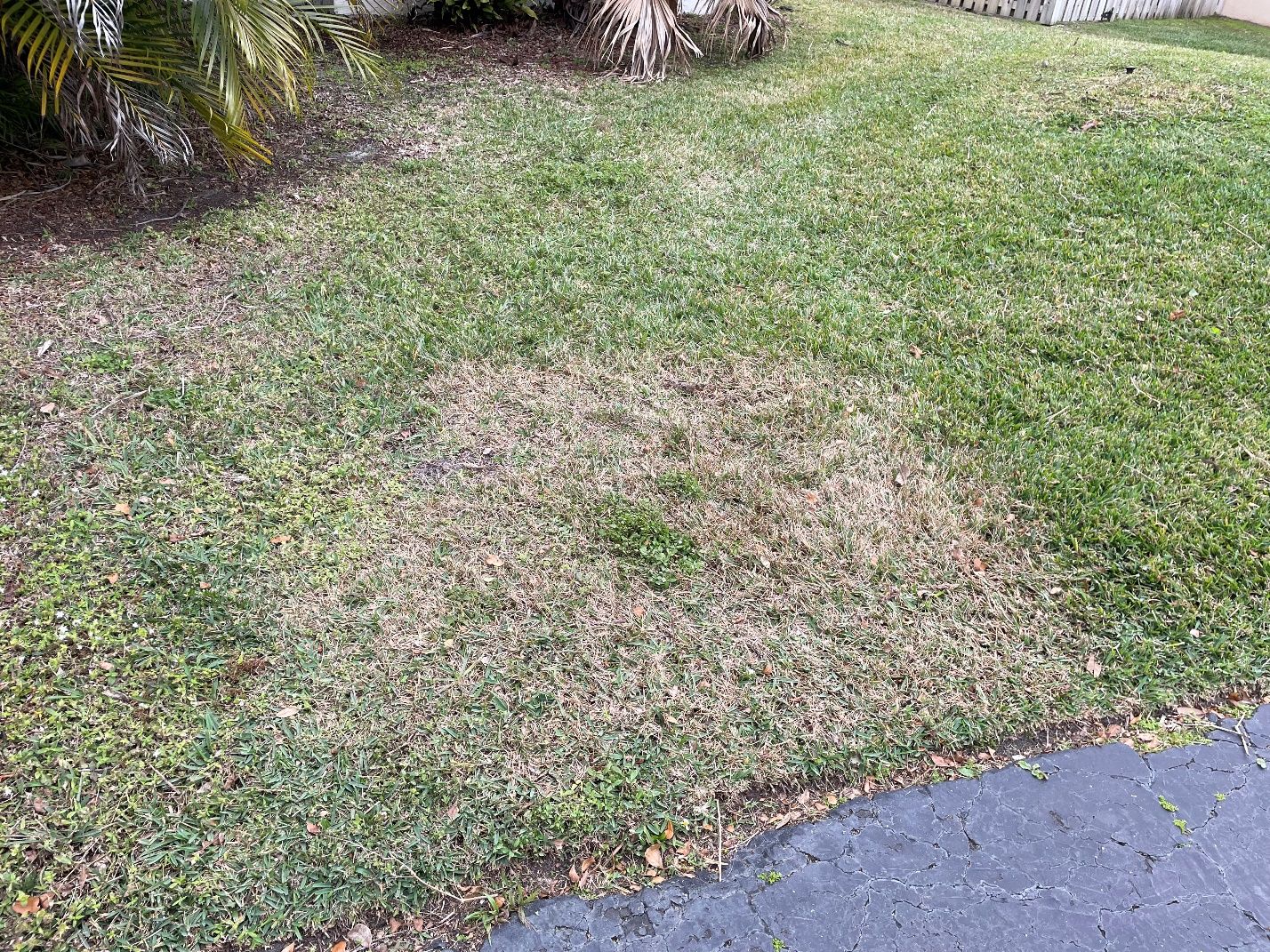
Credit: Marco Schiavon, UF/IFAS
Gray leaf spot (Pathogen: Pyricularia grisea, also referred to as Magnaporthe grisea): Florida's frequent warm and rainy periods create ideal conditions for the development of this fungal disease (Harmon et al. 2005). The fungus not only hinders the establishment of new turfgrass by slowing grow-in but also weakens established stands, eventually leading to significant thinning (Figure 2). In severe cases, it can devastate large areas of St. Augustinegrass, resulting in substantial damage to lawns and landscapes. More information on gray leaf spot can be found at https://edis.ifas.ufl.edu/publication/PP126.
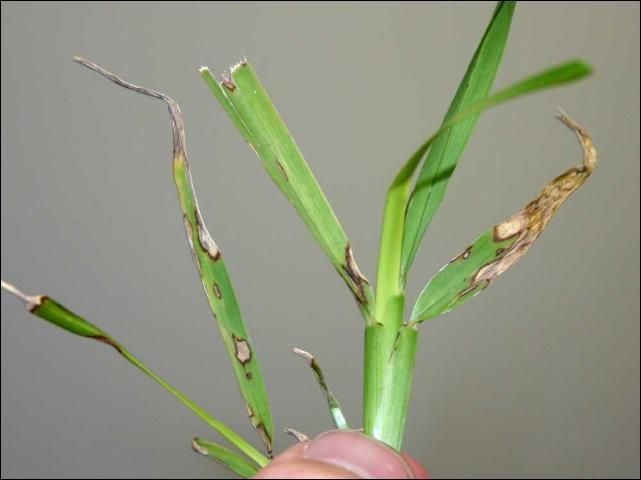
Credit: Phil Harmon, UF/IFAS
Pythium root rot (Pythium spp.): Though not a true fungus, Pythium belongs to the group of organisms called oomycetes that share characteristics with fungi such as filamentous growth and spore development. They are naturally occurring in the soil and are also more commonly known as water molds. Symptoms may appear at any time of the year, but they are always associated with wet soil conditions, either from excessive rainfall or irrigation. Poor drainage conditions compound this problem (Elliott and Harmon 2011). More information on Pythium root rot can be found at https://edis.ifas.ufl.edu/publication/LH050.
Take-all root rot (Gaeumannomyces graminis var. graminis): The pathogen for take-all root rot is prevalent in summer and early fall months and coincides with waterlogged soils (Elliott and Harmon 2014). The affected roots will become brittle and have a decaying appearance. Due to the water and nutrient uptake impairment, the turf will also begin to thin and weaken as it yellows and browns in color. An overall decline in vigor will be shown in stunted growth that will eventually cause turfgrass death in severe cases (Figures 3 and 4). More information on take-all root rot can be found at https://edis.ifas.ufl.edu/publication/LH079.
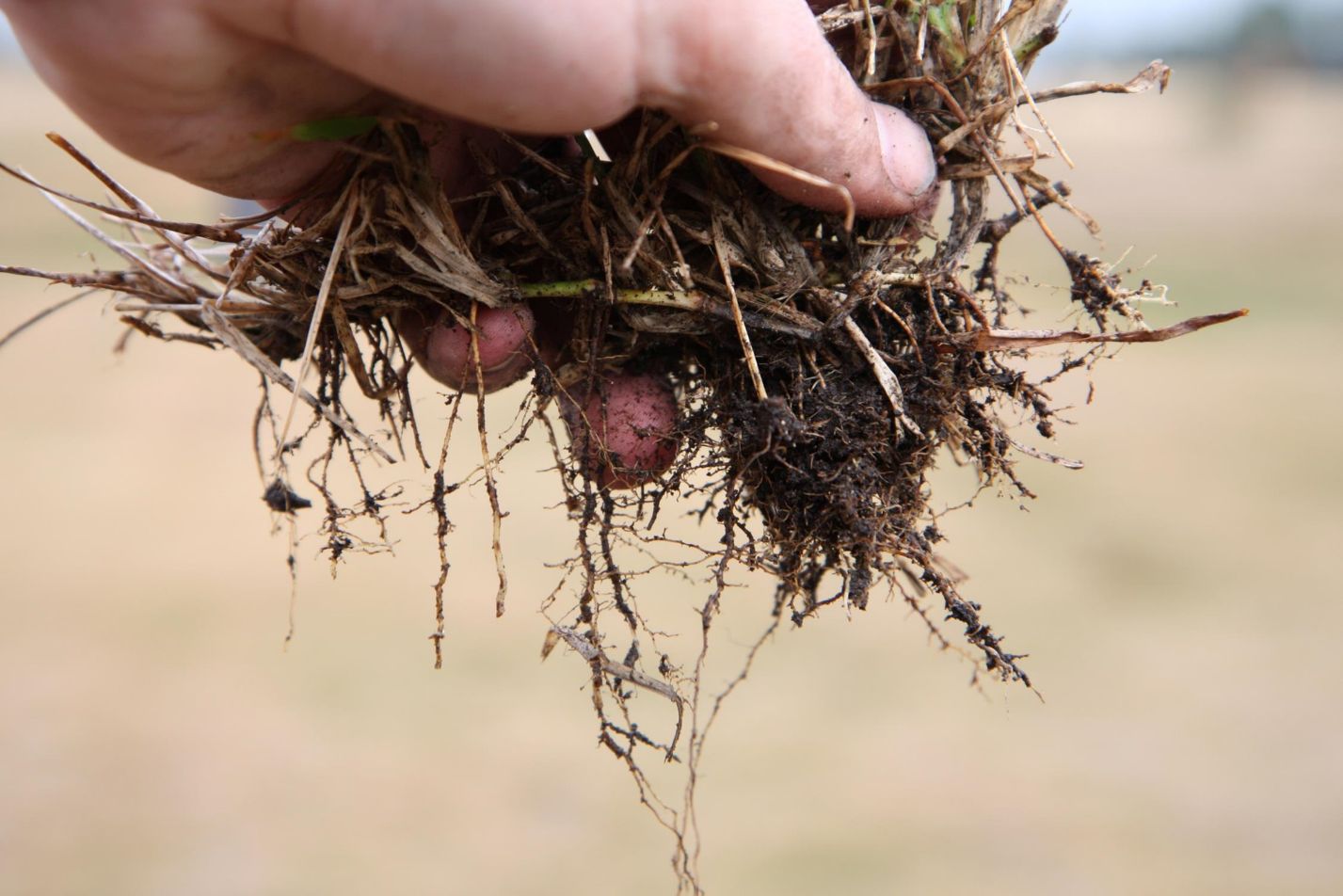
Credit: P. F. Harmon
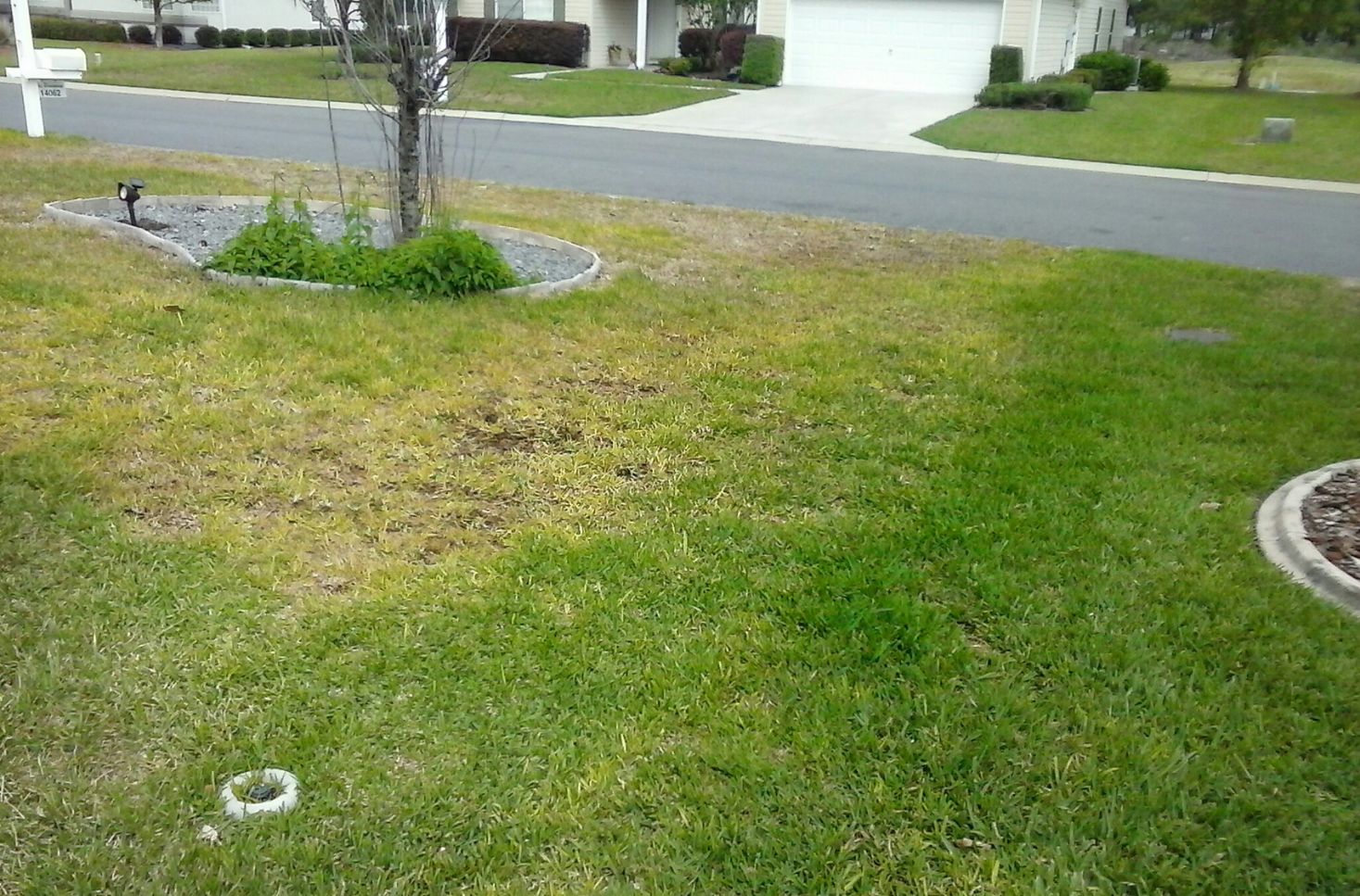
Credit: P. F. Harmon
Soil moisture status can be determined by soil sampling as well as soil moisture sensing. However, soil sampling is not often the method chosen to schedule irrigation cycles for turfgrass. Soil moisture sensor systems are more commonly used because they are faster, not intrusive, and can be permanently installed at representative locations (Dukes, Shedd, and Cardenas‑Lailhacar 2009). These sensors provide repeated moisture readings over time that can be used for efficient irrigation management (https://edis.ifas.ufl.edu/publication/AE437). Homeowners can acquire soil moisture sensors from hardware stores, reliable online vendors, and garden centers. These sensors can be useful for regular monitoring and checks as well as adjusting irrigation based on present needs.
3. Depletion of Nutrients
Turfgrass tends to struggle with utilizing nutrients needed for plant growth when overwatering has occurred. The loss of nutrients occurs from nutrients like nitrogen and phosphorous leaching downward through the soil column (Dukes et al. 2020). Surplus water leaching will also transport the dissolved forms of nutrients present in the root zone away from areas where they are available to the plants. Nutrient loss will diminish turf and exacerbate its vulnerability to stressors such as diseases and pests. There are also environmental impacts of nutrient leaching. Excess nutrients in groundwater and surface waters can cause problems such as harmful algal blooms. Keeping a regular water schedule will help with soil nutrient retention.
Problems That Occur When Nutrients Are Leached
- Nitrogen depletion: Nitrogen is vital for turfgrass growth, but it is readily leached as nitrate due to its high solubility (Reisinger, Lusk, and Smyth 2020).
- Groundwater contamination: Leached nitrate can contaminate groundwater, making it unsafe for human consumption. High nitrate levels in drinking water have been linked to health issues such as methemoglobinemia, or "blue baby syndrome," in infants.
- Eutrophication of water bodies: When leached nutrients such as nitrogen and phosphorus enter nearby lakes, rivers, or coastal waters, they can cause excessive algal blooms. These blooms deplete oxygen levels in the water, harming aquatic life and disrupting ecosystems (Dukes et al. 2020).
- Soil imbalance: Nutrient leaching can create an imbalance in soil fertility, reducing the effectiveness of fertilizers and requiring more frequent applications. This increases costs for homeowners and landscape managers while compounding environmental impacts.
Best Practices for Turf Watering
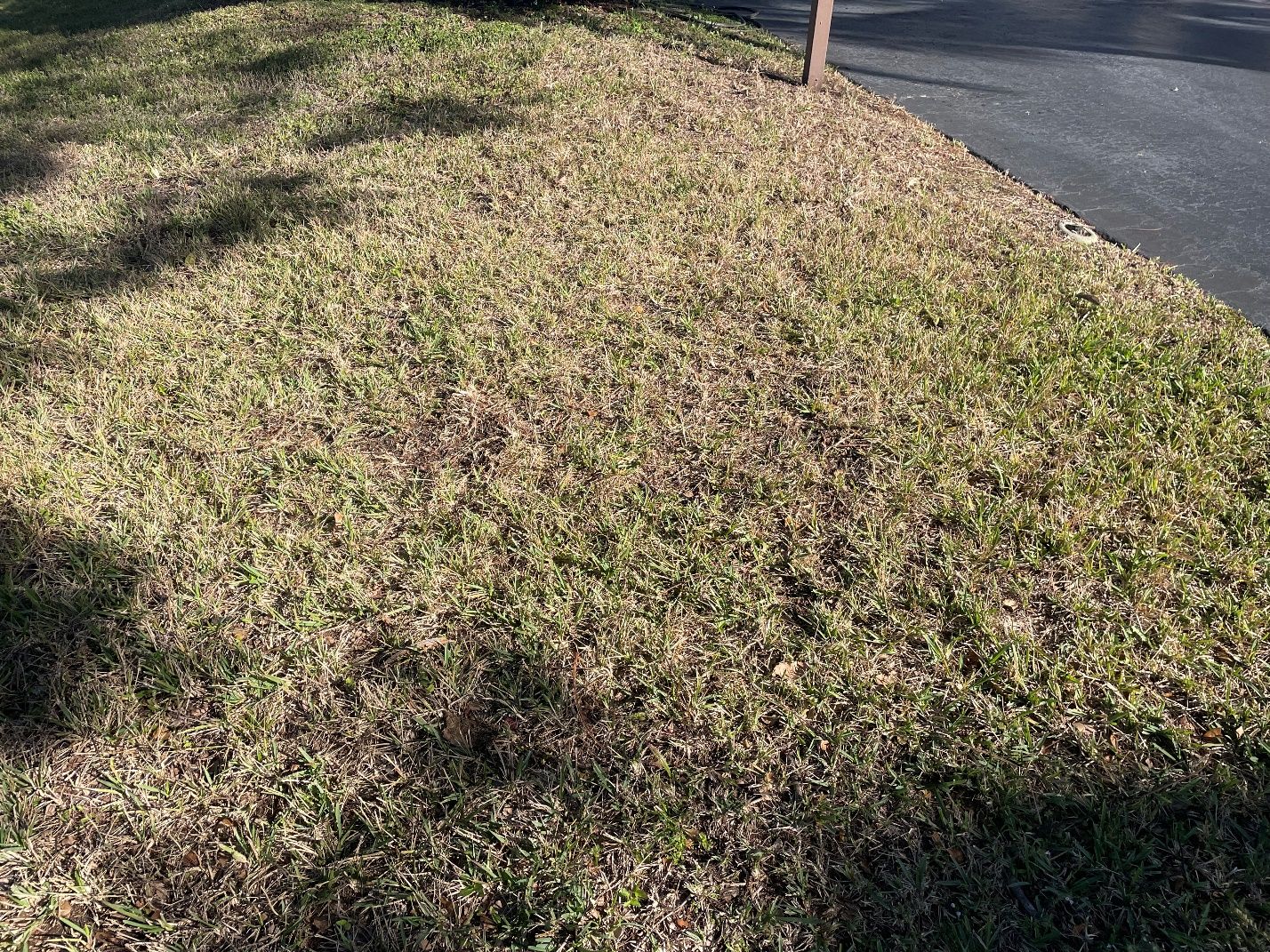
It is recommended to only irrigate established turf on an as-needed basis when the turf is showing signs of drought stress (Figure 5).
Credit: Marco Schiavon, UF/IFAS
Using the best turf watering techniques is essential to keeping a robust and healthy lawn. The following recommendations come from UF/IFAS.
Use deep and infrequent irrigation: It is often advised to irrigate "deep and infrequently" (0.5–0.75 inches of water) during droughts when water shortage orders are in effect. Note, however, that your turf’s needs will be based on the location (i.e., north, central, or south Florida), irrigation application rates, and time of the year (Trenholm et al. 2002; Trenholm et al. 2013).
Consider evapotranspiration (ET): Evapotranspiration is the process by which water is moved from the plant and soil surfaces to the atmosphere by both soil evaporation and plant transpiration. This happens throughout the day but is at its peak in the warmest hours with maximum sunlight. ET rates are lower when the morning and evening hours reduce the prevalence of sunlight. Watering during this time will allow the water to seep into the soil and be absorbed by the plant roots.
Utilize water-efficient irrigation systems: Minimize wasteful water use by implementing water-efficient irrigation systems such as drip irrigation or soaker hoses. These will provide water directly to the root zone (Dukes et al. 2009; Trenholm et al. 2002; Trenholm et al. 2013). However, this is more practical for landscape beds or pots rather than for turfgrass. The larger areas of lawn require overhead irrigation to ensure uniform water distribution. Even these systems can be water-efficient if properly maintained and operated. Visually inspect the sprinkler path and ensure there are no obstacles that could impair efficient distribution of water.
Replace obsolete irrigation systems: Over time, irrigation systems can become outdated or inefficient, leading to water waste and uneven coverage. Replacing older systems with modern, high-efficiency options — such as rotary nozzles or drip irrigation in suitable areas — can significantly reduce water use while maintaining the health of your lawn. Ideally, newer systems are designed with precision in mind, delivering water directly to where it is needed and minimizing runoff.
Be consistent when replacing sprinklers: If you need to replace individual sprinklers or parts of your system, use equipment compatible with your current setup to avoid mismatched flow rates and uneven watering patterns. For example, mixing sprinkler types (such as rotors and spray heads) in the same zone can lead to inefficient watering and dry or overwatered patches.
Measure irrigation uniformity: To measure the efficiency of your irrigation system and identify uneven water distribution, conduct what is called a catch can test. This is a simple test that can help determine whether your lawn is receiving adequate and uniform water coverage. Follow these steps:
- Prepare the test area: Place several small, identical containers (such as tuna cans, measuring cups, or catch cans) across your lawn or irrigation zone. Make sure the containers are evenly spaced and stable and will not tip over during the test.
- Run the irrigation system: Turn on your sprinkler system for a set period. Fifteen minutes is generally an appropriate amount of time. Make sure to run the test during your regular watering schedule to mimic the usual conditions.
- Measure water collection: After the sprinklers have run, use a ruler to measure the depth of water collected in each container. Record the measurements for each container.
- Evaluate distribution: Compare the water levels across all containers. In an ideal scenario, the water depth should be consistent in all containers. Significant variation indicates uneven watering, which may require adjustments to the system.
- Calculate application rate: To determine how much water your lawn is receiving, multiply the average depth of water in inches by 4 (to convert to hourly rate). For example, if the average water depth is 0.25 inches after 15 minutes, your irrigation system applies 1 inch of water per hour.
- Adjust: Use the data to adjust your irrigation schedule or sprinkler system settings. If some areas are overwatered or underwatered, reposition sprinklers, adjust nozzles, or repair damaged equipment to improve coverage. Additionally, assessing the cone of spray and adjusting it with an appropriate screwdriver can mitigate water loss if performed on a frequent basis.
Monitor your soil moisture: To ensure your soil is not too wet nor too dry, use soil moisture sensors or visually inspect your soil if you feel confident in knowing your turf’s soil moisture needs. Modify your watering plan as needed and consider the short-term weather conditions in your area.
Avoid watering when the weather does it for you: If rain is expected, remember to turn off your automatic irrigation system. Take the next step toward efficiency by installing rain sensors. The concept of "set and forget" is the worst approach to irrigation management. Automatic systems should not mean relinquishing supervision. Without proper oversight, these systems can waste water, harm your plants, and increase your water bill.
Achieving balance of watering can be easier with an irrigation schedule. Here are some tips for a robust schedule that can optimize irrigation:
- Adapt to seasonal changes: Adjust your irrigation schedule as temperatures and daylight hours change. Cooler seasons typically require less watering.
- Know your soil type: Sandy soils drain quickly, while clay soils retain moisture longer. Tailor your watering frequency accordingly.
- Water early: Schedule irrigation for the early morning hours to minimize evaporation and fungal diseases.
- Group plants by need: Place plants with similar water requirements together to ensure efficiency.
Aerate your soil: Aeration promotes root development and water infiltration by strengthening the structure of the soil (Lusk and Toor 2017). Verticutting and dethatching are practices for maintaining a healthy lawn in areas prone to thatch buildup. Thatch is a dense layer of organic matter that accumulates between the soil and grass blades. Thatch can inhibit water infiltration, block nutrient absorption, and prevent air from reaching the soil, ultimately weakening your turf. These practices work by slicing through the thatch layer or raking it out, allowing water, nutrients, and air to penetrate the soil more effectively. Verticutting involves creating small vertical cuts in the soil and thatch, breaking up the layer, and integrating the organic material back into the soil. Dethatchers, on the other hand, physically pull the thatch layer to the surface for removal and are ideal for routine maintenance on smaller areas.
Use best practices with reclaimed water: Reclaimed water is former domestic wastewater that has been cleaned and returned to communities for reuse applications, such as lawn irrigation. Reclaimed water is considered safe for lawn irrigation, but it should be used carefully because it can contain elevated levels of nitrogen and phosphorus that can cause environmental harm if applied wastefully or in excess of plant needs (Toor and Lusk 2011; Lusk and Rainey 2021).
Conclusion
The maintenance of healthy, disease-resistant, and drought-tolerant turfgrass requires proper watering strategies. Homeowners and landscape personnel can improve the chances of keeping their lawns resilient and healthy by implementing these practices and by being more informed on the potential consequences of overwatering.
References
Dukes, M., L. Krimsky, M. Lusk, L. E. Trenholm, J. B. Unruh, M. Atkinson, R. Mylavarapu, and C. R. Warwick. 2020. “Urban Fertilizer Ordinances in the Context of Environmental Horticulture and Water Quality Extension Programs: Frequently Asked Questions: AE534, 2/2020.” EDIS 2020(1). https://doi.org/10.32473/edis-ae534-2020
Dukes, M. D., M. Shedd, and B. Cardenas-Lailhacar. 2009. “Smart Irrigation Controllers: How Do Soil Moisture Sensor (SMS) Irrigation Controllers Work? AE437/AE437, rev. 3/2009.” EDIS 2009(2). https://doi.org/10.32473/edis-ae437-2009
Elliott, M. L., and P. F. Harmon. 2018. “Large Patch: SS-PLP-5/LH044.” EDIS. https://edis.ifas.ufl.edu/publication/LH044
Elliott, M. L., and P. F. Harmon. 2011. “Pythium Root Rot: SS-PLP-11/LH050, rev. 2/2011.” EDIS 2011(2). https://doi.org/10.32473/edis-lh050-2011
Elliott, M. L., and P. F. Harmon. 2014. “Take-all Root Rot: SS-PLP-16/LH079, 8/2014.” EDIS 2014(8). https://doi.org/10.32473/edis-lh079-1994
Harmon, P., L. Datnoff, R. Nagata, M. Brecht, and C. Stiles. 2005. “Gray Leaf Spot of St. Augustinegrass: Cultural and Chemical Management Options: PP-204/PP126, 3/2005.” EDIS 2005(3). https://doi.org/10.32473/edis-pp126-2005
Lusk, M. G., and D. Rainey. 2021. “Best Management Practices for Irrigating Lawns and Urban Green Spaces with Reclaimed Water: SL491/SS704, 12/2021.” EDIS 2021(6). https://doi.org/10.32473/edis-ss704-2021
Lusk, M. G., and G. S. Toor. 2017. “Optimizing the Hydrologic Properties of Urban Soils.” In Urban Soils, edited by R. Lal and B. A. Stewart. 175–198. Advances in Soil Science. Boca Raton, FL: Taylor & Francis Group, CRC Press. https://doi.org/10.1201/9781315154251-9
Reisinger, A. J., M. Lusk, and A. Smyth. 2020. “Sources and Transformations of Nitrogen in Urban Landscapes: SL468/SS681, 3/2020.” EDIS 2020(2). https://doi.org/10.32473/edis-ss681-2020
Toor, G. S., and M. Lusk. 2011. “Reclaimed Water Use in the Landscape: What’s in Reclaimed Water and Where Does It Go? SL337/SS542, 1/2011.” EDIS 2011(2). https://doi.org/10.32473/edis-ss542-2011
Trenholm, L. E., E. F. Gilman, and G. W. Knox. 2002. “Fertilization and Irrigation Needs for Florida Lawns and Landscapes.” EDIS.
Trenholm, L. E., J. B. Unruh, and J. L. Cisar. 2013. “Watering Your Florida Lawn: ENH9/LH025, 4/2013.” EDIS 2013(6). https://doi.org/10.32473/edis-lh025-2013