
Overview: Coyotes in Florida
There are many perspectives and misconceptions regarding coyotes (Canis latrans) in Florida. Some people enjoy seeing and hearing coyotes and consider them important components of Florida ecosystems (Figure 1). Others consider them a nuisance or a threat. This publication provides basic information about coyotes and specifically addresses questions that Extension professionals are commonly asked about coyotes. The intended audience for this publication is anyone who is concerned about or interested in learning more about coyotes in Florida.
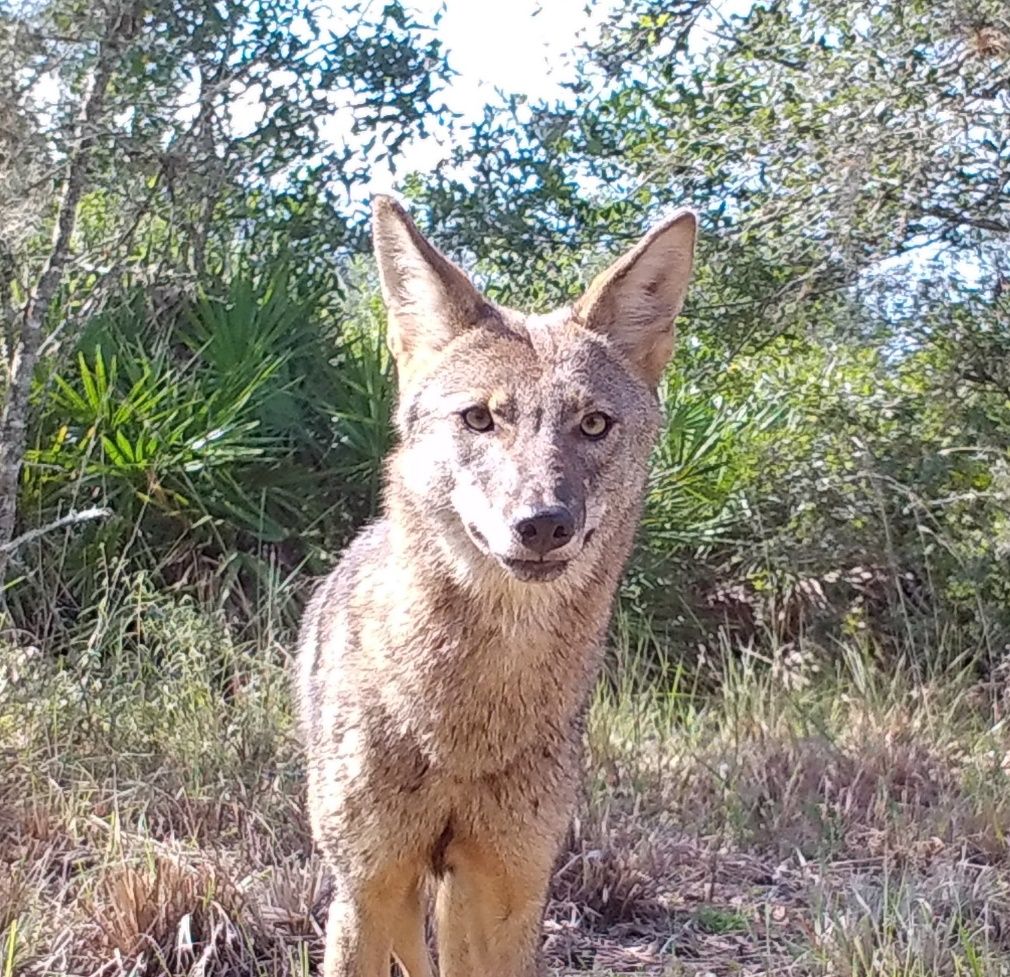
Credit: Hance Ellington, UF/IFAS.
What are some of the basic physical and biological facts about coyotes?
Coyotes are canids, which means they are members of the dog family (Canidae). Florida coyotes typically weigh between 20 and 40 pounds, which is the equivalent of a small- to medium-sized dog. The fur (pelage) of coyotes can vary from light brown (typical), to reddish, to black (melanistic) (Figure 2).
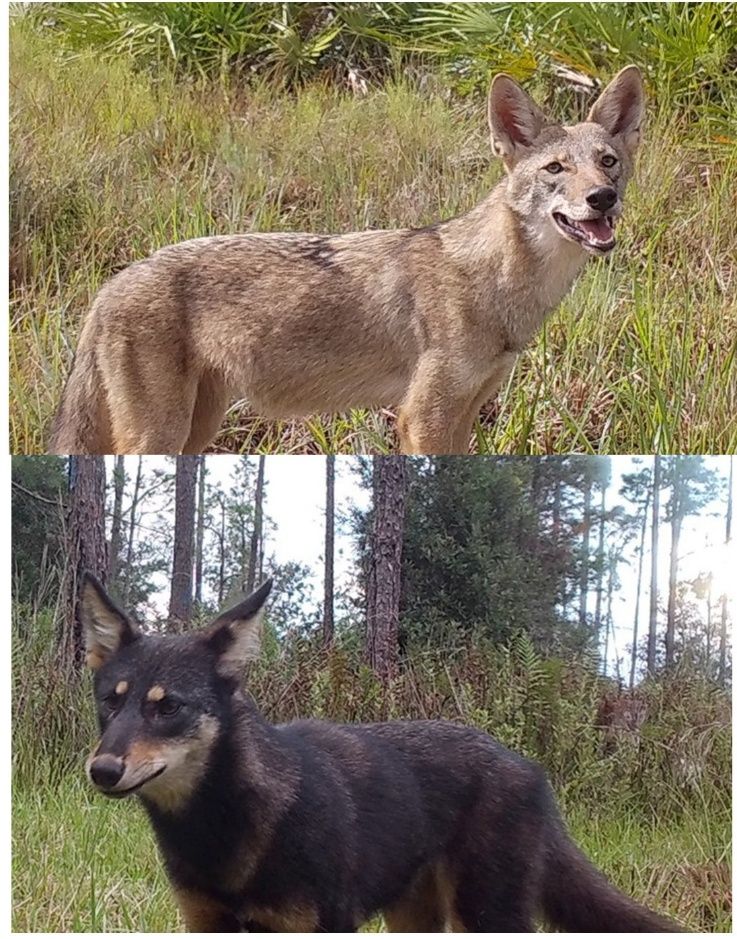
Credit: Hance Ellington, UF/IFAS.
Adult male and female coyotes form strong pair bonds and may mate for life. They are territorial and will defend their territory from intrusion by unrelated coyotes. Pups are typically born from March through May, usually in litters of 5–7 pups. Both parents contribute to raising offspring. Pups stay with the family group during the first year and then usually disperse (leave the territory they were born in). Family groups may sometimes hunt together, but coyotes do not typically form packs as wolves do. Pack behavior is an adaptation for hunting large prey, and coyotes usually prey on smaller animals such as rodents, rabbits, and fawns.
Are coyotes native to Florida?
There has been debate about whether coyotes should be considered a native, nonnative, or invasive species in Florida. The three criteria for a species to be considered invasive in a given area are that the species: 1) is nonnative; 2) is introduced by humans, whether intentionally or unintentionally; and 3) causes or has the potential to cause economic, environmental, or human harm (see the EDIS.IFAS.ufl.edu publication Standardized Invasive Species Terminology for Effective Outreach Education).
Historically, at least since the time of European colonization of the Americas, coyotes occurred in western and central North America, and little evidence exists to suggest that coyotes occurred in eastern North America, including Florida, at that time. The native canid (dog family) carnivore that occurred in Florida was the red wolf (Canis rufus), which, at 45–80 pounds, was roughly twice the size of modern-day coyotes (Figure 3). Wild red wolves roamed the Florida landscape until they were extirpated by intensive predator control programs in the early 1900s. Today, red wolves are captively bred on St. Vincent Island, Florida, and a small wild population that was introduced in North Carolina in the 1980s continues to survive in an area that includes several National Wildlife Refuges.
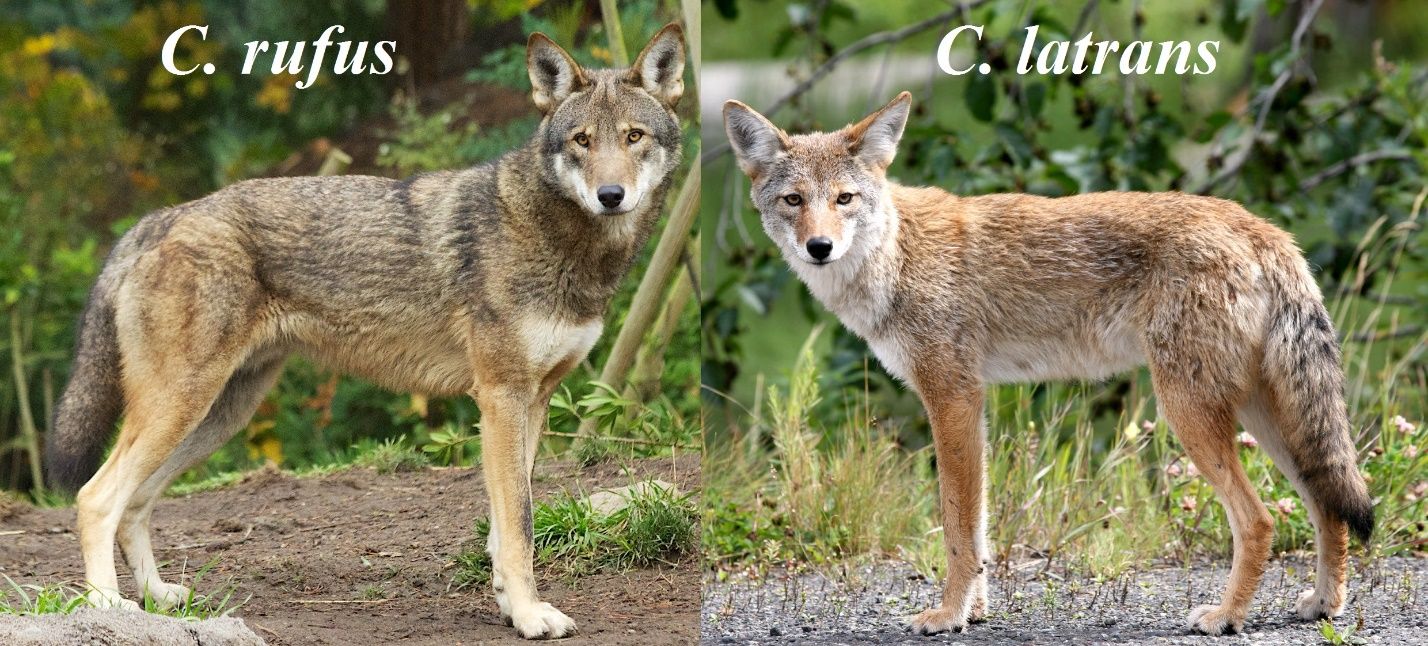
Credits: C. rufus, B. Bartel/USFWS, CC-BY-NC-SA 2.0, and C. latrans, J. Couperus, licensed under CC0 1.0 Universal.
So, are coyotes an introduced species? Should they be considered a nonnative species or an invasive species in Florida? Although there are reports that a small number of coyotes were released in Florida by hunters for the purpose of pursuing them with hunting dogs during the early 1900s, this is unlikely to be the source of the current-day coyote population in Florida. The more compelling evidence is that coyotes populated Florida as part of their extensive range expansion that occurred across North America. Coyotes began expanding their range across the continent during the early 1900s due to two main reasons. One was the extirpation of wolves, which were the major predator of coyotes, and the other was agricultural expansion, which cleared forests and created more open landscapes that coyotes prefer due to abundant food resources such as rodents and other small mammals. Consequently, coyotes proliferated and spread across the country, eventually appearing in the Florida Panhandle in the late 1960s. Since then, coyotes have spread throughout the state and are now well-established in every county. The scientific consensus and the official determination by the Florida Fish and Wildlife Conservation Commission, therefore, is that coyotes are an established species in Florida due to range expansion, not an introduced or invasive species.
Do coyotes live in residential areas, and are they a threat to people or their pets?
Coyotes have proven to be highly adaptable, and there are numerous studies that have documented coyotes living in residential and even highly urbanized areas throughout the United States and Canada, including Florida. In fact, coyotes are common in Pinellas County, one of the most urbanized counties in the state. Coyotes will den and raise pups in parks, vacant lots, golf courses, and other areas that provide some degree of security in otherwise highly developed landscapes. Coyotes are diet generalists and eat a wide variety of food items that include both plants (e.g., fruit) and animals. In addition to hunting prey such as rodents and rabbits, urban coyotes also often feed on items provided by humans either intentionally or unintentionally, such as pet food left outdoors and food scraps in unsecured garbage (Kluever et al. 2022). Coyotes are also known to prey upon cats and small dogs that are left unattended outdoors, especially during spring when raising pups. For these and other reasons, small dogs should be kept on short leads in areas where coyotes are known to occur, and cats should never be allowed to roam freely.
Instances of coyotes biting people are exceedingly rare and have typically been associated with coyotes that became habituated to people and lost their fear of humans due to being fed or for other reasons. A study investigating instances of coyotes biting people in the United States and Canada from 1960 to 2006 documented 142 instances where coyotes bit or attacked people, which equates to three attacks per year over a 46-year timeframe. To place this in perspective, the website DogsBite.org reports that in the United States, roughly 1,000 people require emergency care treatment for serious dog bites every day, more than 12,000 people are hospitalized due to dog bite injuries every year, and dog attacks were responsible for the deaths of 433 Americans from 2005 to 2018, which equates to 33 deaths per year. In other words, the risk of attack and injury from coyotes is far smaller than the risk of attack and serious injury from domestic dogs.
This does not mean coyotes are never a concern. Coyotes that lose their fear of people and exhibit bold or aggressive behaviors, such as approaching children or attacking pets, pose a serious threat and should be reported to the Florida Fish and Wildlife Conservation Commission at myfwc.com. The greatest risk from coyotes is to toddlers and small children and serious attacks have been documented, including the death of a 3-year-old in California in 1981. The only other documented death attributed to coyotes was during October 2009 when a 19-year-old woman hiking alone in Cape Breton Highlands National Park, Canada, was fatally attacked by several coyotes. This unusual and tragic event was investigated, and it was determined that coyotes in this region were hunting in groups and preying primarily upon moose due to the low abundance of smaller prey. This dearth of their usual prey presumably led to the highly unusual attack on the human victim (Gehrt et al. 2022). Again, hunting large prey in packs is not typical behavior for coyotes, especially not in areas with abundant smaller prey, such as occurs in Florida.
What about mange and rabies?
Wild animals, including coyotes, may carry diseases and parasites that can potentially affect pets. Mange, which is curable, is a disease caused by a parasitic mite that causes hair loss and skin lesions. Mange is transferred via direct contact, so transmission between coyotes and pets is unlikely to occur. Rabies is the most serious disease that has the potential to be transmitted by coyotes to people and pets. In Florida, the principal reservoir species for rabies are reported to be raccoons and bats. However, all mammals have the potential to be infected by and transmit rabies through a bite or scratch, and the majority of rabies cases in humans in Florida have been from infected dogs and cats that were not immunized (Florida Department of Health 2016). Rabies is fatal in humans unless treated immediately, so a bite or scratch from any wild or free-ranging mammal merits immediate medical attention. For more detailed information about rabies in wildlife, please see the EDIS.IFAS.ufl.edu publication Facts about Wildlife Diseases: Rabies.
Are coyotes a threat to livestock?
Coyotes are often accused of preying upon livestock, and there are documented cases of coyotes killing livestock, especially smaller animals such as calves, goats, and sheep. However, coyotes are also scavengers and will feed on livestock that have died from other causes, which may in part be responsible for the perceived high rates of predation reported by some livestock producers in Florida. Concern over the potential economic impact of calf predation by coyotes and other predators resulted in two separate studies conducted by UF/IFAS researchers. Collectively, these two studies radio-tagged and monitored 711 newborn calves from birth until post-weaning on five ranches in south Florida. Calves on these ranches died for various reasons, but neither study confirmed any calf depredation by coyotes. The study by Jacobs and Main (2015) monitored 409 calves and documented low levels of calf depredation by the Florida panther and black bear over a two-year period in south Florida. The subsequent study by Koriakin and Boughton (2020) monitored 302 calves, and they had one suspected but unconfirmed case of calf depredation in south-central Florida. Coyotes are predators, and, given the opportunity, may prey upon calves and other small livestock. However, these studies indicate livestock depredation by coyotes is a negligible source of mortality for most Florida cattle ranches. In most situations, coyotes are disincentivized from attempting predation on cow calves for two main reasons:
- Coyotes are diet generalists, and other food sources are typically abundant in Florida; and
- Coyotes are typically risk-averse, and cows, which can weigh more than 1000 pounds, make calves a risky potential prey item.
Do coyotes have positive or negative effects on native wildlife and ecosystems?
Coyotes are predators but have an omnivorous diet and will consume many different food items such as fruit, insects, carrion, and human food waste. As predators, they do kill other animals, which in some cases may include species of conservation concern. For example, coyotes are known to prey on sea turtle nests. However, coyotes are also known to prey upon racoons, which are significant predators of sea turtle nests in Florida.
Hunters are often concerned that coyotes kill white-tailed deer, and this does occur. Coyotes occasionally kill adult deer, but they are a more significant predator of deer fawns, with some studies reporting fawn predation to be above 50% for tagged animals. However, it is important to recognize that coyotes occur everywhere deer occur in North America, and despite predation from coyotes, the overabundance of white-tailed deer in some areas has led to habitat degradation and crop damage and is recognized as a major problem in Florida and throughout the Southeast. Consequently, coyote predation of white-tailed deer may help control high-density deer populations and by doing so serve an important role in protecting habitat for other species and reducing damage to agricultural crops.
Hunters have also raised concerns that coyotes may prey upon quail and wild turkeys. Neither quail nor turkeys are primary prey items of coyotes due to the difficulty associated with capturing them. And, although coyotes will almost certainly eat any eggs they find, they also prey upon small and medium-sized predators that actively hunt for quail and turkey nests, such as rodents, raccoons, and foxes. By preying upon smaller and more abundant nest predators, coyotes may increase nesting success of ground-nesting gamebirds and waterfowl, and this has been demonstrated in some studies (e.g., Sovada et al. 1995).
Coyotes, therefore, can have both positive and negative effects on native wildlife depending on the question being asked and the species being considered. What is clear is that coyotes provide important contributions to Florida ecosystems by helping to maintain ecological balances and keep species such as white-tailed deer, medium-sized predators, and rodents from becoming overabundant (Figure 4).
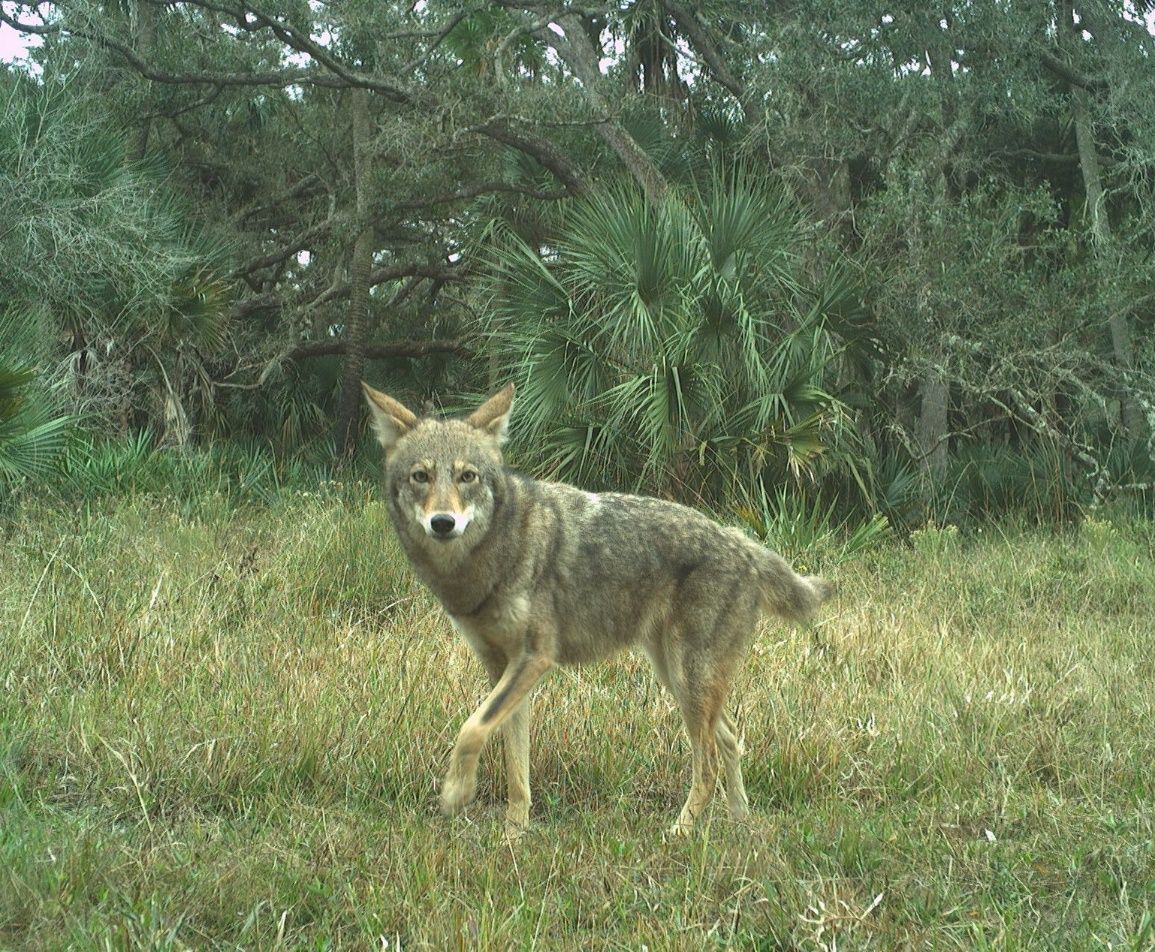
Credit: Credit: Hance Ellington, UF/IFAS.
Why don’t we just eliminate all coyotes from areas where we don’t want them?
The removal of a targeted coyote or potentially several coyotes that have been identified as causing problems or presenting a potential safety threat is a justifiable management decision. However, there are both ethical and practical arguments against efforts to simply extirpate all coyotes from areas where they aren’t wanted by some people. The ethical arguments, which are beyond the scope of this publication, are based on differing perspectives regarding what constitutes nuisance or destructive wildlife and whether those perspectives justify killing coyotes or other wildlife to address various concerns or interests voiced by groups or individuals. From a practical standpoint, the extirpation of coyotes from large areas is expensive, temporary, and ineffective. When coyotes are removed from an area, new coyotes quickly repopulate the available space, which may result in higher coyote densities than were present when territories were defended by established coyote pairs. Consequently, it has proven impractical to eradicate coyotes from large areas, and people who have tried have learned that the better strategy is to take action targeting individual problem animals when needed and to minimize the potential for conflict with coyotes where possible, such as with fencing, preventing access to sources of food, and keeping small pets indoors and on short leads.
Summary
- Coyotes are canid predators that range in weight from 20 to 40 pounds in Florida.
- The presence of coyotes in Florida is the result of range expansion across North America during the last century, and not likely as the result of introductions.
- The Florida Fish and Wildlife Conservation Commission recognizes coyotes as a species that has become established in the state due to the process of range expansion. Coyotes are not considered an introduced nonnative or invasive species.
- Coyotes occur in urban and residential areas throughout Florida and sometimes attack small dogs and cats. Attacks on humans are extremely rare, but people should report coyotes that demonstrate aggressive behaviors toward people (often because people have disregarded warnings to avoid feeding wild animals for the safety of both people and animals). Any aggressive wild animal should be reported to the Florida Fish and Wildlife Conservation Commission. A bite from a coyote or any wild mammal should be considered a potential risk for rabies. Obtain medical treatment immediately.
- UF/IFAS research indicates that coyotes rarely kill calves, but they are known to pose a significant threat to smaller livestock such as goats and sheep.
- The impact of coyotes on native wildlife and ecosystems varies depending upon the species being considered and the questions being asked.
- Attempts to extirpate coyotes from areas are expensive, only temporarily effective if they work at all, and, depending on one’s ethical perspective, often morally questionable.
For More Information
DogsBite.org. A national dog bite victims' group dedicated to reducing serious dog attacks.
Florida Department of Health, 2016. Rabies Background and General Virus Information, Rabies Prevention and Control in Florida. https://www.floridahealth.gov/diseases-and-conditions/rabies/_documents/rabies-background-virus-information.pdf
Florida Fish and Wildlife Conservation Commission: Coyote (Canis latrans), https://myfwc.com/wildlifehabitats/profiles/mammals/land/coyote/.
U.S. Fish and Wildlife Service: Red Wolf. https://www.fws.gov/species/red-wolf-canis-rufus
References
Gehrt, S. D., E. M. Muntz, E. C. Wilson, J. W. B. Power, and S. D. Newsome. 2023. “Severe Environmental Conditions Create Severe Conflicts: A Novel Ecological Pathway to Extreme Coyote Attacks on Humans.” Journal of Applied Ecology 60 (2): 353–364. https://doi.org/10.1111/1365-2664.14333
Hody, J. W., and R. Kays. 2018. “Mapping the Expansion of Coyotes (Canis latrans) across North and Central America.” ZooKeys 759:81–97. https://doi.org/10.3897/zookeys.759.15149
Iannone, B. V., III, E. C. Bell, S. Carnevale, et al. 2021. “Standardized Invasive Species Terminology for Effective Education of Floridians: FOR730 FR439, 8 2021.” EDIS 2021 (4). Gainesville, FL. https://doi.org/10.32473/edis-fr439-2021
Jacobs C. E., and M. B. Main. 2015. “A Conservation-Based Approach to Compensation for Livestock Depredation: The Florida Panther Case Study.” PLoS One 10 (9): e0139203. https://doi.org/10.1371/journal.pone.0139203
Kluever, B. M., M. B. Main, S. W. Breck, et al. 2022. “Using Noninvasive Genetics for Estimating Density and Assessing Diet of Urban and Rural Coyotes in Florida, USA.” Urban Naturalist 9 (51): 1–24
Koriakin, K. 2020. “Understanding Calf Mortality in South Florida: A Unique Approach to Conservation.” (Master’s thesis, University of Florida, 2020.) https://ufdcimages.uflib.ufl.edu/UF/E0/05/69/81/00001/Koriakin_K.pdf
Lovemore, T. E. J., N. Montero, S. A. Ceriani, and M. Fuentes. 2020. “Assessing the Effectiveness of Different Sea Turtle Nest Protection Strategies against Coyotes.” Journal of Experimental Marine Biology and Ecology 533. https://doi.org/10.1016/j.jembe.2020.151470
McCown, W., and B. Scheick. 2007. “The Coyote in Florida.” Fish and Wildlife Research Institute, Florida Fish and Wildlife Conservation Commission. Technical Report. https://myfwc.com/media/1836/coyotewhitepaperfinal.pdf
Sovada, M. A., Sargeant, A. B., and J. W. Grier. 1995. "Differential Effects of Coyotes and Red Foxes on Duck Nest Success.” The Journal of Wildlife Management 59 (1):1–9. https://doi.org/10.2307/3809108.
Tischaefer, R. 2020. “Coyotes.” U.S. Department of Agriculture Animal & Plant Health Inspection Service Wildlife Services. Wildlife Damage Management Series. https://www.aphis.usda.gov/sites/default/files/coyotes-wdm-technical-series.pdf
White, L. A., and S. D. Gehrt. 2009. “Coyote Attacks on Humans in the United States and Canada.” Human Dimensions of Wildlife 14 (6): 419–432. https://doi.org/10.1080/10871200903055326
Wisely, S. M., and H. K. Ober. 2019. “Facts about Wildlife Diseases: Rabies: WEC239 UW282, Rev. 6 2015.” EDIS 2015 (5). Gainesville, FL. https://doi.org/10.32473/edis-uw282-2015