Abstract
This is the third article in the Participatory Action Research (PAR) series that explores the co-design phase of PAR, where Extension professionals and community stakeholders collaboratively construct a research plan. Co-design goes beyond consultation; it is an iterative, inclusive process that centers local knowledge, aligns with community priorities, and ensures contextually appropriate methods. Through a review of literature and examples from agricultural contexts, this publication offers practical strategies for fostering shared goals, clarifying roles, selecting relevant methodologies, and maintaining flexibility. The article also explores themes of power, trust, decolonial research, and scientific integrity. With tools and guidance, Extension professionals can more effectively navigate the co-design process to produce research that is equitable, action-oriented, and scientifically sound.
Introduction
Participatory action research (PAR) is grounded in the premise that research should be conducted not on people, but with them. Co-design, the collaborative planning of a research study between professionals and community members, is the foundational step in operationalizing this principle. It transforms passive participation into genuine partnership by centering community voices in identifying questions, shaping methods, and determining the meaning and relevance of findings (Baum et al., 2006; Chevalier & Buckles, 2019).
Unlike traditional research planning, which often positions academic expertise above local knowledge, co-design in PAR values both equally. This stage is crucial for ensuring not only relevance and legitimacy but also long-term impact. In agricultural and rural settings, where research outcomes affect livelihoods, environments, and community well-being, co-design offers a pathway to more ethical and effective engagement.
The Purpose of Co-Design in PAR
The co-design phase is where ideas turn into real plans. Instead of just preparing for research, co-design shapes how the project will work and ensures that all voices matter from the very beginning.
Key elements of strong co-design include the following.
- Grounding in real needs: Make sure research questions reflect what the community truly cares about (Franz et al., 2010; Kindon, Pain, & Kesby, 2007).
- Fair and workable methods: Choose approaches that are both practical and just.
- Shared accountability: Build trust, respect, and responsibility into every step (Wilson, 2008).
- Balancing goals: Recognize both system-level priorities (such as yield or water management) and social concerns (such as land access or fair pay).
- Iterative planning: Treat co-design as an ongoing conversation, not a one-time meeting (Minkler & Wallerstein, 2008; Chambers, 1997).
- Addressing power differences: Use skilled facilitation to create space for everyone’s voice, especially when hierarchies exist (Jagosh et al., 2012).
- Fostering ownership: Strong co-design leads to deeper community involvement and results that are more relevant and sustainable (Snapp et al., 2019; Wallerstein & Duran, 2010).
When Extension agents approach co-design this way, it moves research from being “done to” communities into something “built with” them, creating stronger partnerships and results that last.
Building Shared Understanding and Goals
The starting point of co-design is clarifying what the project seeks to achieve, and why (Figure 1). This requires returning to initial community dialogues and asking, “What do we want to learn or change together?” Responses may differ; farmers may want practical solutions, while researchers may prioritize generalizable knowledge.
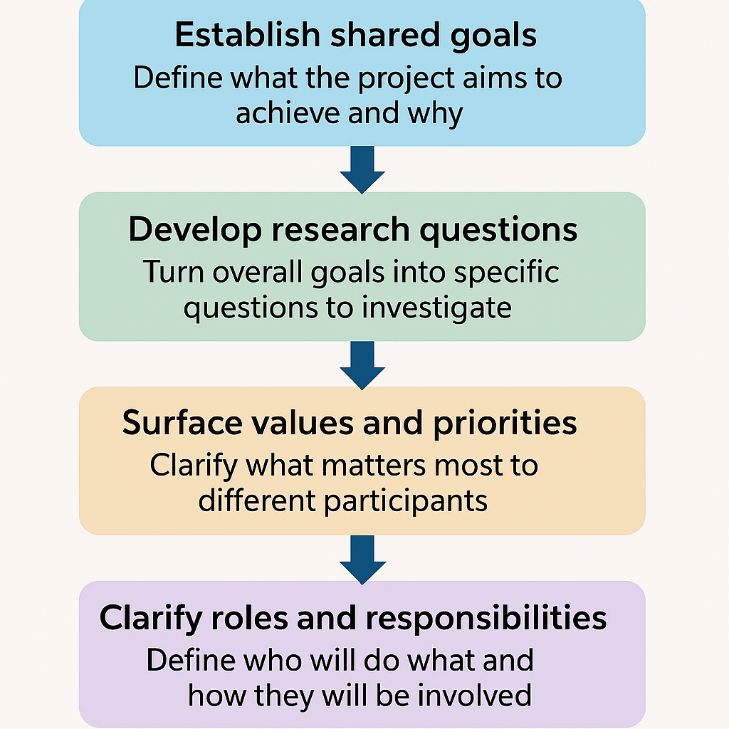
Credit: John Diaz, UF/IFAS
Through participatory activities, such as structured dialogue, problem tree analysis, or outcome harvesting, groups can align their diverse motivations. Facilitated planning sessions incorporating structured dialogue, concept mapping, or logic modeling can help transform broad concerns into researchable questions. For instance, if participants have identified soil degradation as a key issue, the group may define a central research question such as “Which cover cropping strategies improve soil health and crop yield under our local conditions?”
Establishing shared goals also means clarifying values. Are participants more interested in generating new knowledge, solving a practical problem, building relationships, or influencing policy? These priorities may differ among stakeholders, and exploring the priorities early helps prevent confusion or misalignment later in the process.
During this process, it is essential to create space for diverse forms of knowledge and experience. Farmers may bring experiential and cultural insights. Extension agents may contribute technical and systems-level perspectives. These perspectives must be treated as complementary rather than hierarchical (Minkler & Wallerstein, 2008).
Goals should not be forced into uniformity. Divergence can be productive if acknowledged openly and managed through dialogue (Reason & Bradbury, 2008). Facilitators play a key role in supporting this negotiation without asserting their own agendas.
Clarifying Roles and Responsibilities
In co-design, defining roles is about more than logistics; it is about equity. Historical patterns of marginalization in research (especially with Indigenous, rural, or under-resourced communities) make this step crucial. Assumptions that community members will “volunteer” for intensive tasks can reinforce existing power imbalances. Roles in a PAR project often include:
- Facilitators (often Extension professionals), who coordinate activities and ensure inclusive participation.
- Community researchers (e.g., farmers, local leaders), who may contribute to data collection, interpretation, or dissemination.
- Academic partners, who may support evaluation design, analysis, and reporting.
Clear role negotiation helps avoid overburdening certain individuals, especially when some participants are volunteering their time. Co-developing a memorandum of understanding (MOU) or a simple roles-and-responsibilities document can help formalize commitments and expectations (Calderon et al., 2015; Gonsalves et al., 2005).
Compensation should also be discussed openly. If community members are expected to collect data, host field visits, or attend meetings regularly, budgets should reflect this contribution through stipends, honoraria, or material support (Jagosh et al., 2012). Fair compensation reinforces the principle that local expertise is valued and necessary.
PAR can be especially meaningful in agricultural work with Indigenous or historically marginalized communities when it reflects Indigenous perspectives shaped by the impacts of colonization, emphasizing respectful relationships and the collaborative creation of knowledge (Chilisa, 2012). As Chilisa (2012) illustrates, participants in such settings may co-develop job descriptions for roles ranging from data collection to community dissemination in an approach that deepens ownership, clarifies expectations, and helps balance power among collaborators. This practice affirms that co-design is not just about logistics but about embedding equity into every stage of the research. Critically, these roles must include real decision-making authority. Extension professionals and researchers should reflect: Who has the power to revise the plan? Who can say no? Without shared authority, co-design risks becoming performative, undermining both the integrity and the transformative potential of the PAR process (Chilisa, 2012).
Selecting Research Methods Together
Method selection in PAR is a technical, societal, and cultural decision. The tools and strategies used for data collection and inquiry must align not only with the research questions but also with the lived realities, preferences, and capacities of the participants. Methods must be relevant to the questions being asked, feasible for participants to implement or support within their time and resource constraints, and rigorous enough to yield credible, actionable findings. Just as importantly, they must be ethical and inclusive, creating space for a range of voices and reducing barriers to participation (Kindon et al., 2007; Chevalier & Buckles, 2019).
Choosing methods in PAR involves balancing scientific validity with accessibility and cultural appropriateness. For example, participatory mapping, storytelling, and photovoice have all been effectively used in agricultural and rural development contexts because they honor both local knowledge and community expression (Wang & Burris, 1997; Chambers, 1997). This selection process is best approached collaboratively, with participants engaged in assessing trade-offs and co-determining which approaches best support their shared goals (Minkler & Wallerstein, 2008). Ultimately, thoughtful method selection in PAR enhances both the legitimacy of the findings and the empowerment of those who help produce them.
For example, a group interested in testing water conservation practices on farms may consider paired plot trials with simple metrics such as soil moisture or yield. The design must align with farming schedules, avoid disrupting livelihoods, and allow for participant-driven data collection.
In agricultural research, participatory methods such as on-farm trials, mapping, seasonal calendars, storytelling, or photovoice can all be used, depending on the goals. What matters most is that participants understand and feel confident about the approach and that any trade-offs are discussed transparently.
Training and co-learning are vital. Training may be needed for certain data collection or analysis activities. Co-learning events, such as short workshops or peer demonstrations, can ensure everyone is prepared to participate meaningfully. Offering workshops on data literacy or hosting “field trial design cafes” allows participants to grow their research capacity and confidence. Moreover, when methods are co-chosen and co-implemented, the likelihood of real-world application increases.
Creating a Flexible and Responsive Plan
Although the co-design phase culminates in a concrete research plan, that plan must remain adaptable. Agricultural systems are inherently dynamic and affected by variables such as weather, labor availability, crop health, and shifting community needs. Likewise, community-based research is shaped by the evolving lives and perspectives of participants. Participatory action research requires both a tolerance for uncertainty and a commitment to adaptation as new insights emerge (Chambers, 1994).
To support this flexibility, Extension professionals should embed regular opportunities for reflection and recalibration into the project timeline. Scheduled check-ins, mid-season reflection meetings, or informal feedback loops provide structured moments for participants to assess progress, identify challenges, and adjust course as needed. These mechanisms reinforce the iterative nature of the PAR cycle and signal that the project remains responsive to participants' experiences and contextual realities.
Real-world examples demonstrate the value of this adaptive approach. In a participatory on-farm research project in Florida, farmers and Extension specialists jointly evaluated various cover crop varieties. After the first season, participants found one variety difficult to manage using existing equipment. Through collective discussion, the group decided to remove that variety and substitute a more suitable alternative. They also revised data collection protocols to reflect this change, ultimately enhancing both research outcomes and collaborative trust (Hunt et al., 2025).
Similarly, in a rural Malawi project, researchers convened mid-season reflection circles to review and adapt data collection tools based on participant feedback. This process improved data quality and reinforced community engagement by ensuring that tools remained contextually appropriate (Snapp et al., 2019).
One practical strategy for maintaining flexibility is the use of “living documents,” which are collaboratively developed and regularly updated versions of the research plan. Whether digital or printed, these documents function as shared workspaces rather than rigid blueprints, supporting transparency, adaptability, and collective ownership (Chevalier & Buckles, 2019).
Tools to Support Co-Design
Several tools are available to support Extension professionals and community groups during the co-design phase of PAR, helping to structure the process while maintaining flexibility and responsiveness. One such tool is the use of co-design planning worksheets, or structured templates that guide participants through key tasks such as problem identification, goal setting, role negotiation, and method selection. These worksheets can serve as prompts to facilitate discussion and ensure that the planning process remains inclusive and transparent (Chevalier & Buckles, 2019). For a ready-to-use set of materials, the Experience-Based Co-Design (EBCD) Toolkit from the Australian Healthcare and Hospitals Association offers free, downloadable templates, checklists, and step-by-step guidance for planning, facilitation, and evaluation that can be readily adapted for Extension PAR projects. Access the toolkit and its templates here: https://ahha.asn.au/resource/experience-based-co-design-toolkit/.
Collaborative logic models are another valuable resource. Adapted from traditional planning tools, these models help teams visualize how resources, actions, and outcomes connect, including community-defined priorities placed alongside formal goals. For instance, in the Paulatuk Arctic cooking circle PAR project, community members co-created the Mukluk Logic Model, embedding cultural practices and capacity-building goals together with nutrition outcomes (Dedyukina et al., 2023). Participatory research agreements, often in the form of short memoranda of understanding (MOUs), also help clarify expectations. A practical example comes from the Community Research Collaborative, which offers a freely available partnership agreement template designed to be co-developed by researchers and community partners. This template guides collaborators through defining goals, roles, decision-making processes, data use, and governance as a “living document” to revisit regularly (Community Research Collaborative, n.d.). Used together, collaborative logic models and MOUs equip Extension professionals with tools to co-design PAR projects that are inclusive, transparent, and grounded in shared ownership.
Finally, decision-making frameworks such as consensus-building techniques (e.g., the Delphi technique) (Warner, 2024; https://edis.ifas.ufl.edu/publication/wc183) and structured multi-voting processes (e.g., the nominal group technique) (Bammer et al., 2023; https://edis.ifas.ufl.edu/publication/WC410) offer inclusive routes for group decisions around methods, timelines, and evaluation plans (Kindon et al., 2007). The Delphi technique guides practitioners through iterative rounds of anonymized expert input to achieve consensus, while the nominal group technique provides a four-stage, face-to-face process for generating and prioritizing ideas in small groups. These tools not only promote transparency and fairness but also help teams navigate complex choices in ways that honor collective input and diverse perspectives. Together, these frameworks enhance the co-design process by making it more participatory, equitable, and aligned with participatory action research principles (Kindon et al., 2007).
Importantly, these tools should serve the group — not the other way around. Facilitators must adapt tools to the group’s literacy, language, time, and cultural context. The goal is not to formalize for the sake of documentation but to clarify and empower. It is important to avoid overly bureaucratic documents and to keep tools simple, visual, and co-created.
Addressing Power, Equity, and Trust
The co-design phase is deeply influenced by the dynamics of power. Whose knowledge counts? Who gets to speak? Who controls resources? Extension professionals must approach co-design with humility and reflexivity. They should ask:
- Am I listening more than I speak?
- Whose absence am I not noticing?
- What histories am I stepping into?
PAR encourages us to move away from “top-down” approaches where researchers take information from communities without giving much back. Instead, it calls for building relationships where knowledge is created together, based on mutual respect and shared benefit (Smith, 2012; Chilisa, 2012). This involves fostering sustained partnerships, recognizing the influence of individual and collective perspectives, and collaboratively shaping strategic plans, shared values, and desired outcomes. Trust is both an input and an outcome of co-design. It takes time to build and seconds to lose. Transparent communication, follow-through, and honoring community labor are essential to sustaining it (Chilisa, 2012).
Promoting Ownership and Scientific Integrity
Critics sometimes argue that participatory processes compromise scientific objectivity or rigor. However, growing evidence shows that PAR, when co-designed effectively, produces more reliable, applicable, and ethically sound findings (Jagosh et al., 2012; Skinkis, 2019). Community ownership enhances data quality. Participants better understand the reasons for the data collection, are more invested in accuracy, and often suggest context-specific indicators overlooked by traditional researchers.
Moreover, ownership supports dissemination. When participants have helped build the research, they are more likely to share the results within their networks, present at community events, or advocate for policy change (Skinkis, 2019). Co-design creates pathways for broader impact by anchoring science in lived experience. Scientific integrity is not compromised by co-design; it is strengthened by grounding research in the realities of lived experience.
Conclusion
The co-design phase of participatory action research is where intentions are translated into action. It is the process through which Extension professionals and community members jointly shape the inquiry to reflect their collective priorities, knowledge, and realities. This stage requires time, trust, negotiation, and the ability to balance community-driven insight with sound research practice.
For Extension professionals, co-design is a skill set that blends facilitation, systems thinking, cultural humility, and applied research expertise. When practiced with care, it sets the foundation for projects that are both scientifically robust and deeply rooted in the communities they aim to serve. Their ability to navigate complexity, support equity, and honor diverse knowledge systems determines the quality and impact of the research. When practiced thoughtfully, co-design transforms research from a transactional project into a transformational process where everyone learns, contributes, and benefits.
References
Australian Healthcare and Hospitals Association. (2017, December 1). Experience-based co-design toolkit. https://ahha.asn.au/resource/experience-based-co-design-toolkit/
Bammer, M., Benge, M., & Warner, L. A. (2023). Conducting the needs assessment #9: The nominal group technique: WC410/AEC749, 1/2022. EDIS, 2022(1). https://doi.org/10.32473/edis-wc410-2022
Baum, F., MacDougall, C., & Smith, D. (2006). Participatory action research. Journal of Epidemiology and Community Health, 60(10), 854–857. https://doi.org/10.1136/jech.2004.028662
Calderón, J. L., Norris, K. C., Hardigan, P. C., Calderón, L. A., & Hays, R. D. (2015). Case study of an unsustainable community-academic partnership: Toward core standards for the structure of emerging participatory research. Ethnicity & Disease, 25(3), 363–372. https://pubmed.ncbi.nlm.nih.gov/26673638/
Chambers, R. (1997). Whose reality counts? Putting the first last. Intermediate Technology Publications. https://doi.org/10.3362/9781780440453.000
Chevalier, J. M., & Buckles, D. J. (2019). Participatory action research: Theory and methods for engaged inquiry (2nd edition). Routledge. https://doi.org/10.4324/9781351033268
Chilisa, B. (2012). Indigenous research methodologies. Sage Publications.
Community Research Collaborative. (n.d.). Partnership agreements (memorandum of understanding). Retrieved August 20, 2025, from https://communityresearchcollaborative.org/partnership-agreements-mous/
Dedyukina, L., Wolki, C., Wolki, D., Wesche, S. D., Kenny, T. A., & Skinner, K. (2023). Process evaluation of a cooking circle program in the Arctic: Developing the Mukluk Logic Model and identifying key enablers and barriers for program implementation. Canadian Journal of Program Evaluation, 38(2), 219–242. https://doi.org/10.3138/cjpe-2023-0031
Franz, N. K., Piercy, F., Donaldson, J., & Westbrook, J. (2010). Farmer, agent, and specialist perspectives on preferences for learning among today's farmers. The Journal of Extension, 48(3), Article 16. https://doi.org/10.34068/joe.48.03.16
Gonsalves, J., Becker, T., Braun, A., Campilan, D., De Chavez, H., Fajber, E., Kapiriri, M., Rivaca-Caminade, J., & Vernooy, R. (Eds.). (2005). Participatory research and development for sustainable agriculture and natural resource management: A sourcebook (Vol. 2: Enabling PR&D). International Potato Center — UPWARD & IDRC. Retrieved from https://idrc-crdi.ca/sites/default/files/openebooks/182-5/index.html
Hunt, L., Thompson, J. J., & Niles, M. T. (2025). How on-farm research project participants compare to a general sample of farmers: A case study of US cover crop farmers. Agronomy for Sustainable Development, 45(1). https://doi.org/10.1007/s13593-024-01004-z
Jagosh, J., Macaulay, A. C., Pluye, P., Salsberg, J., Bush, P. L., Henderson, J., Sirett, E., et al. (2012). Uncovering the benefits of participatory research. Milbank Quarterly, 90(2), 311–346. https://doi.org/10.1111/j.1468-0009.2012.00665.x
Kindon, S., Pain, R., & Kesby, M. (Eds.). (2007). Participatory action research approaches and methods. Routledge. https://doi.org/10.4324/9780203933671
Minkler, M., & Wallerstein, N. (2008). Community-based participatory research for health (2nd edition). Jossey-Bass.
Reason, P., & Bradbury, H. (2008). The SAGE handbook of action research (2nd edition). Sage Publications. https://doi.org/10.4135/9781848607934
Skinkis, P. A. (2019). Participatory research engages industry. Journal of Extension, 57(4). https://doi.org/10.34068/joe.57.04.20
Smith, L. T. (2012). Decolonizing methodologies: Research and Indigenous peoples (2nd edition). Zed Books.
Snapp, S. S., DeDecker, J., & Davis, A. S. (2019). Farmer participatory research advances sustainable agriculture. Agronomy Journal, 111(6), 2681–2691. https://doi.org/10.2134/agronj2018.12.0769
Wallerstein, N., & Duran, B. (2010). Community-based participatory research contributions. American Journal of Public Health, 100(S1), S40–S46. https://doi.org/10.2105/AJPH.2009.184036
Wang, C., & Burris, M. A. (1997). Photovoice: Concept, methodology, and use for participatory needs assessment. Health Education & Behavior, 24(3), 369–387. https://doi.org/10.1177/109019819702400309
Warner, L. A. (2024). Using the Delphi technique to achieve consensus: A tool for guiding Extension programs. AEC521. EDIS. https://edis.ifas.ufl.edu/publication/wc183
Wilson, S. (2008). Research is ceremony: Indigenous research methods. Fernwood Publishing.